
Most people buy a leather jacket the same way: they see one they like, try it on if they can, and hope for the best. Sometimes that works. More often, the jacket turns out to be a little too stiff, a little too short in the sleeve, or not leather at all. This guide explains how to choose a leather jacket in Pakistan with confidence. It brings together everything we wish every buyer knew before spending money on a jacket meant to last for years, from how leather is graded to how it should fit, and from how it copes with a Karachi monsoon to what it needs during a Lahore winter.
- Grade first: full-grain and top-grain leather last longest; bonded leather and PU are not hides and wear out quickly.
- Hide second: cowhide and buffalo are tough and warm, goatskin is light and strong, lambskin is the softest but scuffs more easily.
- Fit at the shoulders: the shoulder seam should sit at your shoulder bone, because a tailor cannot easily change it.
- Match the weight to your city: a medium jacket for Punjab's short winter, heavier for Islamabad and the north, lighter for Karachi.
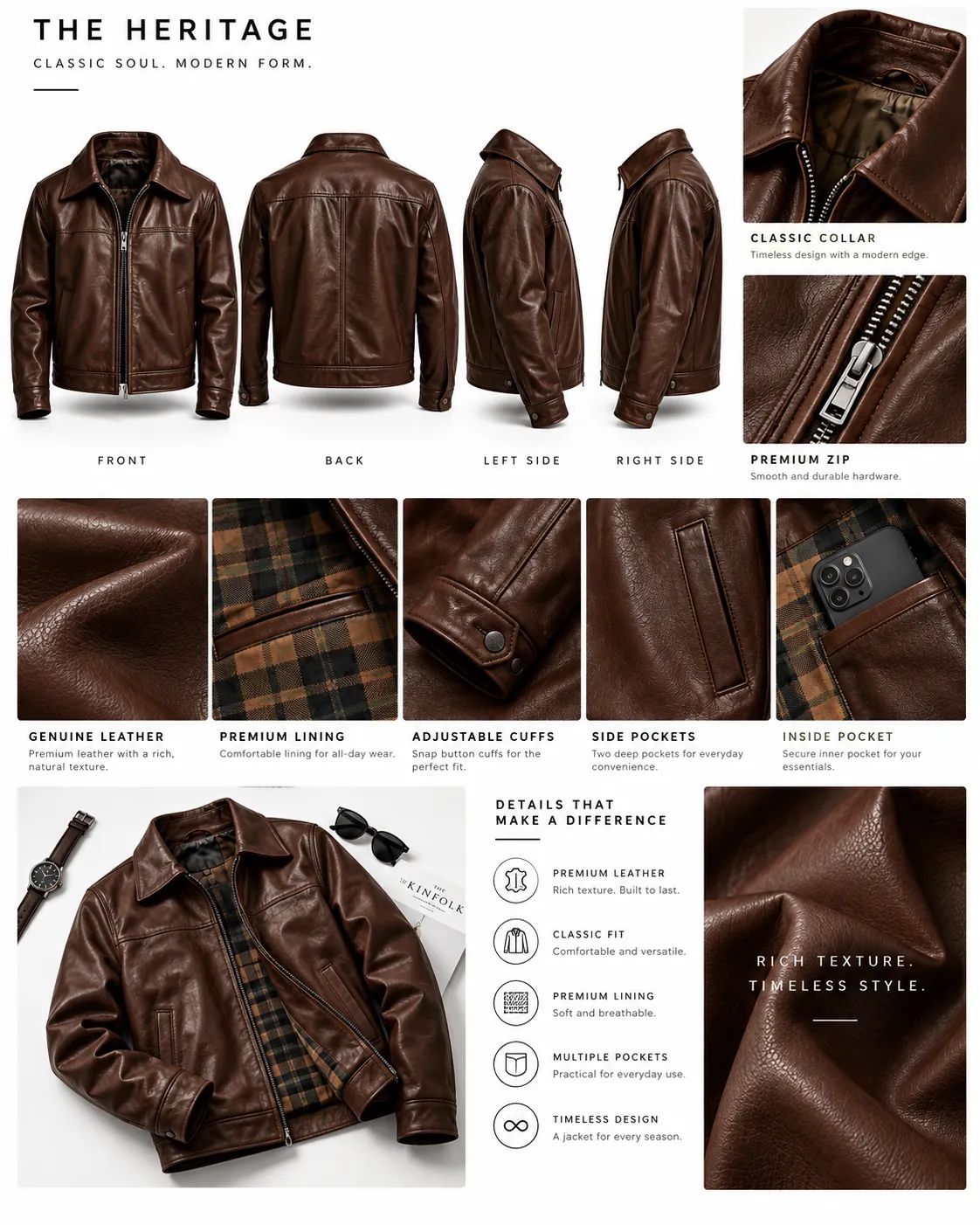
- Check the build: even stitching, matched panels, smooth zips, a lining that lies flat and neatly finished edges.
- Buy from a seller who shows every angle, lists measurements and states what the jacket is made of.
Read it start to finish, or jump to the part you need.
Leather grades: which leather is best for a jacket?
A hide is thick, so tanneries slice it into layers. Which layer a jacket is cut from, and how much the surface has been worked on, decides most of what you will feel and see for the life of the garment. Sellers use these words loosely, so it helps to know what they are supposed to mean.
- Full-grain: the top layer, left with its natural grain intact. Small marks and variations stay visible. It is the strongest grade, breathes well, and is the one that slowly darkens and softens into a patina.
- Top-grain: also the top layer, but lightly sanded and given a finish to even out the surface. It looks more uniform and resists stains a little better, though it ages less dramatically.
- Corrected grain: a surface that has been sanded more heavily and then stamped with an artificial grain pattern. It is neat and affordable but tends to feel flatter and can look tired sooner.
- Split leather and suede: the lower layers left after the top is removed. Suede is split leather brushed into a soft nap. Comfortable and handsome, but it marks easily and dislikes water.
- Nubuck: the grain side buffed until it has a short, velvety nap. It feels like suede but is tougher, and just as quick to show stains.
- Bonded leather: leather scraps ground up and glued onto a backing. It is not a hide, and US Federal Trade Commission guidance says it should not be sold as plain "leather". It usually peels within a few seasons.
- PU or "vegan leather": a plastic coating on fabric. It can look convincing in photos, but it does not breathe, and it cracks rather than ages.
If you want to test a jacket you already have, our article on telling real leather from imitations walks through the checks in more detail.
Cowhide, buffalo, goat or lamb?
The animal matters as much as the grade. Each hide has its own weight, grain and temperament, and none is simply "best". The right one depends on how and where you plan to wear the jacket.
| Hide | Feel and weight | Strengths | Worth knowing |
|---|---|---|---|
| Cowhide | Firm, medium to heavy | Tough, protective, holds its shape | Needs a few weeks of wear to soften |
| Buffalo | Thick, with a bold grain | Very hard-wearing, widely used in South Asia | Heavier, so better suited to real winter |
| Goatskin | Light, with a pebbled grain | Strong for its weight, flexible | The visible grain is part of the look |
| Lambskin or sheepskin | Very soft and light | Drapes well, comfortable from day one | Scuffs and scratches more easily |
As a rough rule, choose a heavier hide if the jacket will face cold wind on a motorbike, and a lighter one if you mostly wear it for an evening out or in a mild city.
How tanning changes the jacket
Raw hide would rot, so it is tanned to make it stable. The method leaves a lasting mark on the finished jacket.
Chrome tanning uses mineral salts and takes a day or two. It produces leather that is soft, supple and fairly tolerant of moisture, which is why it is used for most garment leather around the world. Vegetable tanning relies on plant tannins and can take weeks. The result is firmer and earthier, and it darkens noticeably with sunlight and handling. You will see it more often in belts, bags and boots than in soft jackets. Neither is automatically better; they simply behave differently. What matters more is whether the tannery did the job carefully, and that shows up in the quality checks further down.
Types of leather jackets: the main styles
Leather jackets come in a handful of classic shapes. Knowing their names makes it far easier to describe what you want and to compare like with like.
- Biker or rider: an off-centre zip, wide lapels that snap down, and often a belt at the waist. Bold and unmistakable.
- Racer or café racer: a clean front, a short stand collar and a close fit. Minimal, sharp, and easy to dress up or down.
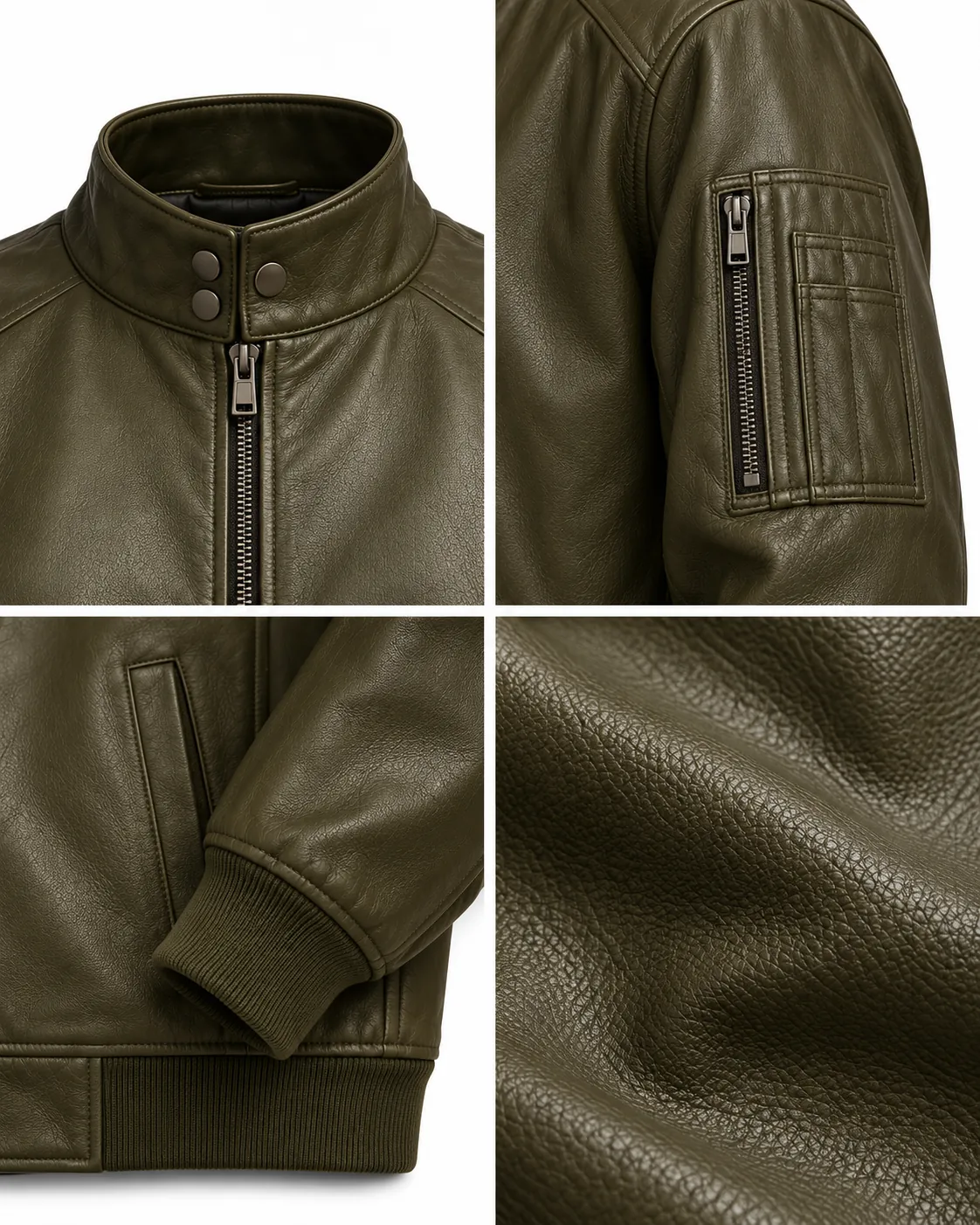
- Bomber: a fuller body gathered into ribbed cuffs and a ribbed hem. Relaxed, warm and casual.
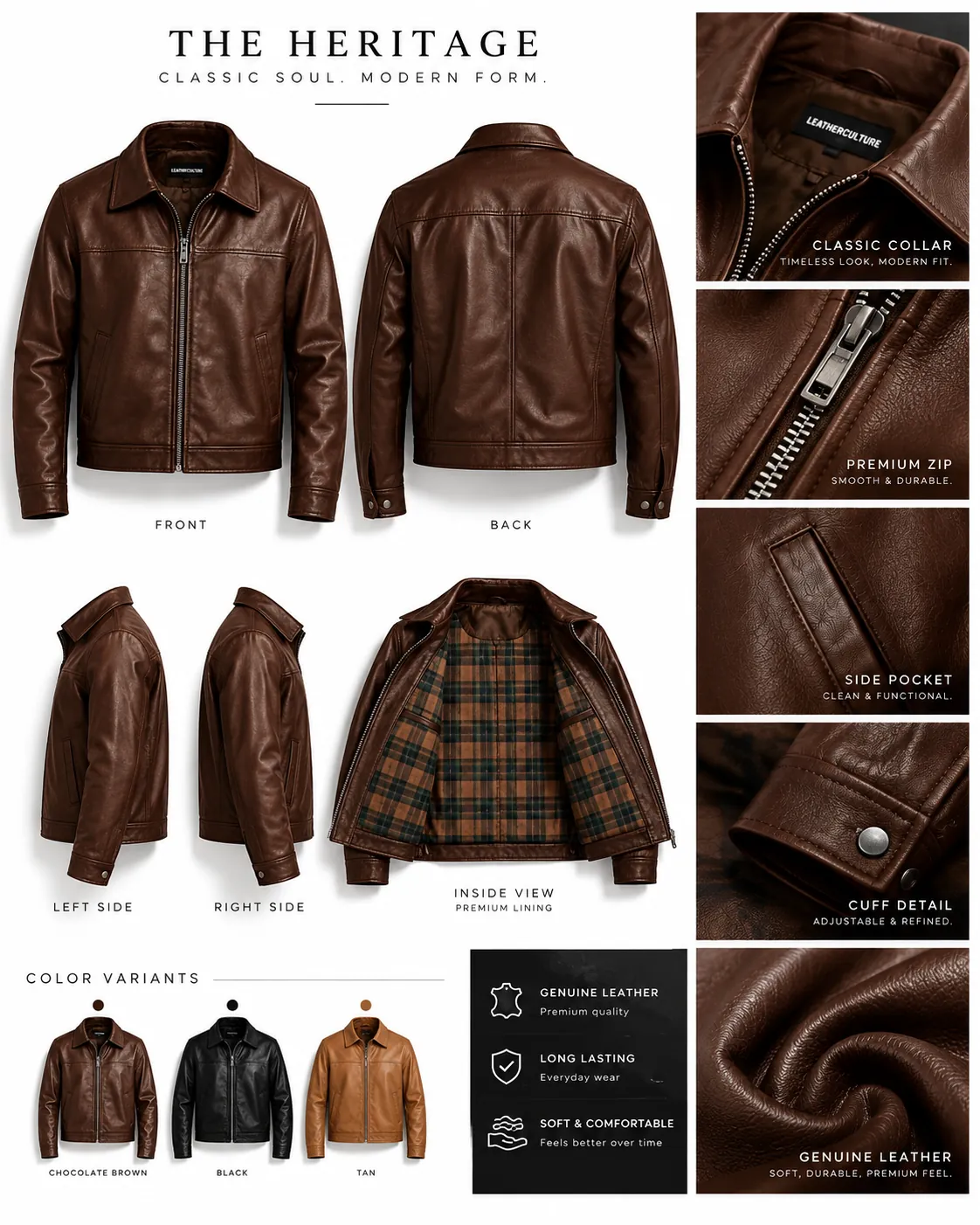
- Collared or trucker: a shirt-style collar, usually with a centre zip or buttons. The most versatile shape for everyday wear.
- Hooded: a leather or fabric hood added for a sportier, street-led look.
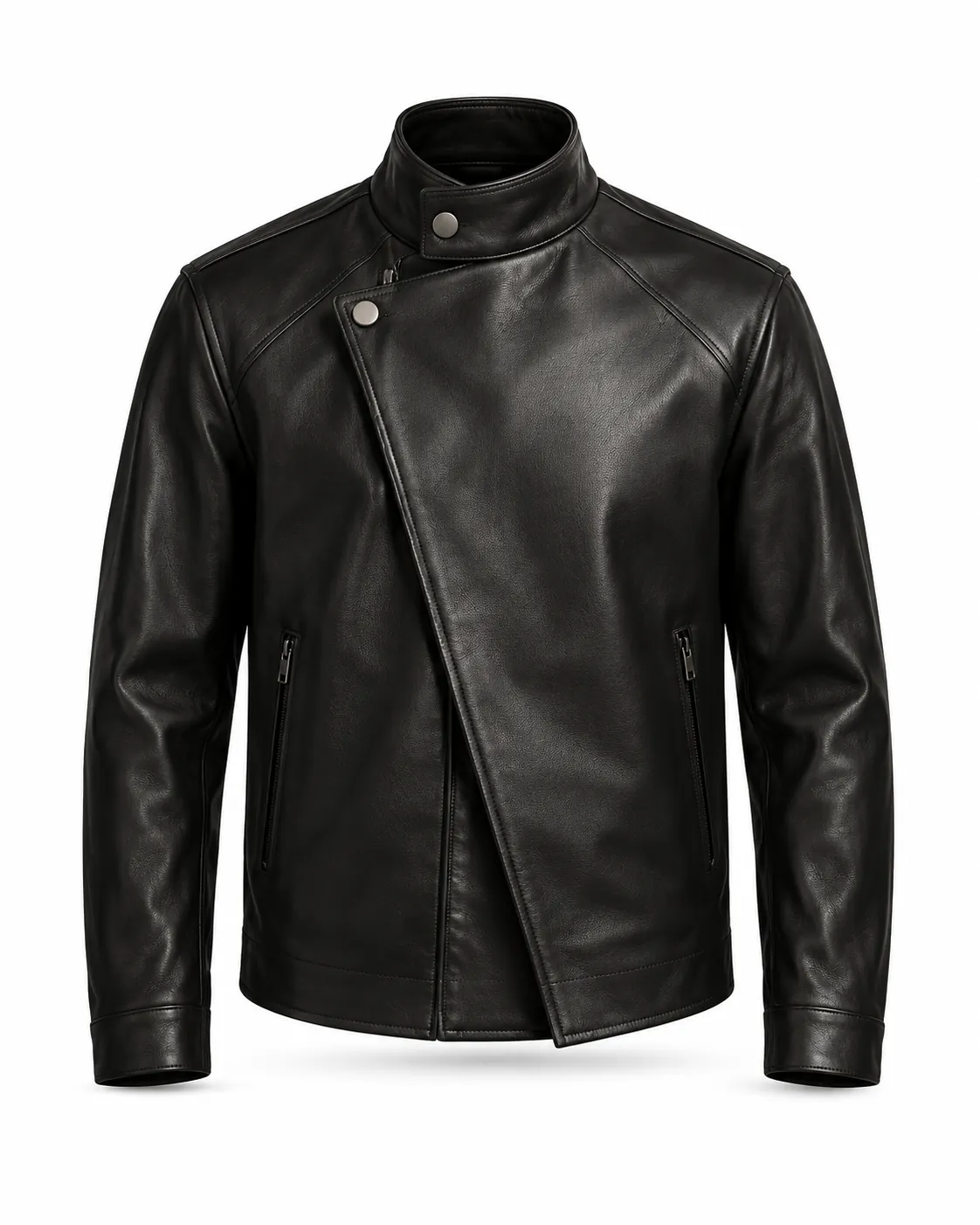
- Asymmetric: a closure that runs at an angle across the chest, giving a familiar shape a more modern edge.
- Long coat or trench: mid-thigh or longer, built for proper cold and smarter occasions.
Our own collection covers several of these: The Heritage is a collared jacket, The Nomad has a snap stand collar, The Blade adds a hood, The Rune uses an asymmetric zip, and The Vibe sets white contrast panels against black.
How should a leather jacket fit?
A leather jacket that fits well looks expensive whatever it cost, and one that fits badly never looks right, however good the leather. Four measurements do most of the work.
- Shoulders. The shoulder seam should sit on, or just at the edge of, your shoulder bone. This is the one thing a tailor cannot easily change, so get it right first.
- Chest. Zipped up over the layer you plan to wear underneath, you should be able to cross your arms without the back pulling tight. Snug is good; strained is not.
- Sleeves. With your arms relaxed, the cuff should reach roughly the base of your thumb. When you reach forward, it should not ride far up your forearm.
- Length. Most casual jackets should end around the top of the belt or a little below. Bombers sit higher; coats, obviously, longer.
Natural leather relaxes slightly with wear and moulds to your body, but it does not stretch a whole size. Buy the size that fits now, not the one you hope it will become. If you are between sizes, think about what you will wear underneath it in winter. Our sizing guide explains how to measure yourself at home and compare your numbers with a product's measurements.
Choosing for Pakistan's weather
Pakistan does not have one winter. It has several, and they ask different things of a jacket.
- Lahore, Faisalabad and much of Punjab: a short, sharp season from around December to February, with foggy mornings and cold nights. A medium-weight jacket with room for a jumper underneath is ideal.
- Islamabad, Rawalpindi and the north: longer and colder, especially in the evenings and in the hills. A heavier hide, a warmer lining and a collar that closes properly earn their place here.
- Karachi and the coast: winters are mild and short, and humidity is high for much of the year. A lighter jacket you can wear open over a T-shirt will get far more use than a heavy one.
- Quetta and the high north: genuinely cold for months. Think in terms of a heavier jacket or coat, layered well.
Humidity matters as much as temperature. Conservation guidance from the Canadian Conservation Institute notes that relative humidity above 65% favours mould on leather, which is why storage during the monsoon deserves some attention. We cover that below.
Six quality checks you can do in a minute
You do not need to be an expert to spot a well-made jacket. These checks work in a shop, and most of them work from good product photos too.
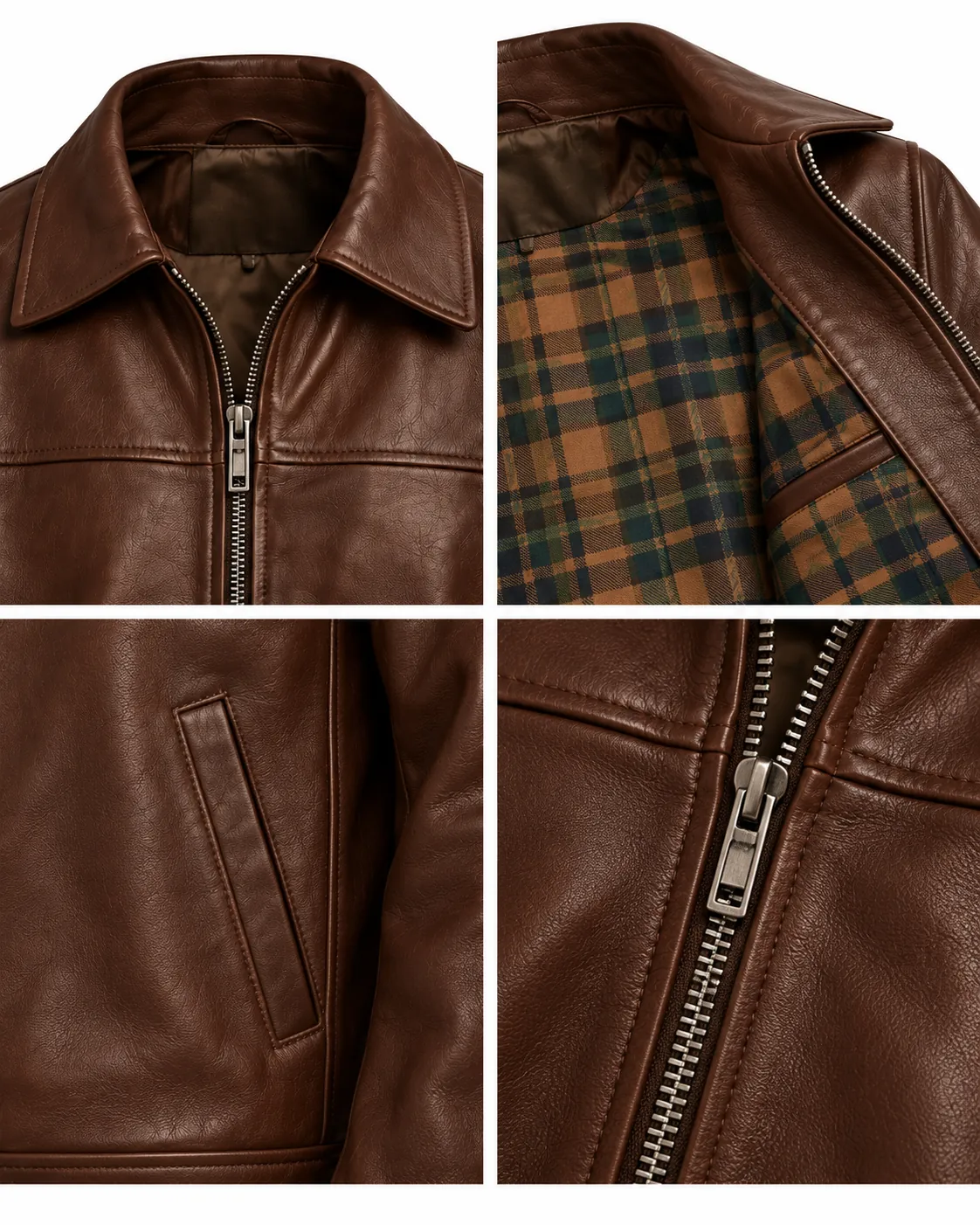
- Stitching: look for small, even, straight stitches with no loose threads. Double rows of stitching on stress points such as shoulders and pockets are a good sign.
- Panels: fewer, larger panels usually mean better use of the hide. Where panels meet, the colour and texture should match.
- Zips and hardware: zips should run smoothly without catching. Snaps should close firmly. Heavy, well-finished metal parts tend to outlast light, shiny ones.
- Lining: it should lie flat, be stitched in cleanly and not pull when you move your arms. A lining that is too tight will tear long before the leather wears out.
- Edges: on cuffs, collars and pocket openings, edges should be folded or finished neatly, not left rough.
- The leather itself: real leather has small, irregular variations in its grain. Press it gently and it should wrinkle softly and recover. A perfectly repeating pattern is a warning sign.
What the price actually pays for
Two jackets can look nearly identical in a photo and still be worlds apart in price. The difference usually comes down to the grade and type of hide, how carefully it was tanned, how many panels were needed, the quality of the zips and lining, and how much hand work went into finishing. Very low prices for "genuine leather" deserve a second look, because something in that list has had to give. We break this down further, with the questions to ask a seller, in our guide to leather jacket prices in Pakistan.
Care in one page
Leather is forgiving, but it does have a few firm dislikes: direct heat, prolonged sun, plastic covers and harsh chemicals. Avoid those and most of the work is done.
| When | What to do |
|---|---|
| Every couple of weeks in season | Wipe off dust with a soft, dry cloth. |
| After rain | Blot it dry and hang it at room temperature, away from heaters and hairdryers. |
| Twice a year | Apply a little leather conditioner with a cloth, wait, then wipe off the excess. |
| Before summer storage | Clean it, use a broad hanger, cover it with cotton, and leave space around it for air. |
| Stubborn stains | Take it to a specialist leather cleaner rather than a general dry cleaner. |
For the full routine, including what to do about oil spots and water marks, read how to look after a leather jacket in Pakistan.
Wearing it well
The reason a leather jacket earns its place in a wardrobe is that it works with almost everything. A few combinations that rarely fail:
- Everyday: a plain white or grey T-shirt, dark straight-leg jeans and clean white trainers.
- Evening: a fine knit or a dark shirt, tailored trousers and leather shoes. A brown or collared jacket suits this best.
- Cold days: a hoodie or a chunky jumper underneath, provided you bought the jacket with room for it.
- With traditional wear: a short, clean-lined jacket over a kurta and straight trousers is increasingly common, especially in muted colours.
Keep the rest of the outfit simple and let the jacket do the talking. Our piece on building a simple wardrobe around one leather jacket has more ideas.
Is leather a responsible choice?
It is a fair question, and the honest answer has two sides. Most leather comes from hides that are a by-product of the meat industry and would otherwise go to waste. A well-made jacket can also last ten years or more, which is far longer than most synthetic alternatives, and a garment you keep for a decade is usually lighter on the planet than several you replace every season. On the other side, tanning uses water and chemicals, and how responsibly that is managed varies a great deal between tanneries. The most practical thing a buyer can do is choose a jacket built to last, look after it, and repair it rather than replace it.
Buying online without regret
Buying a leather jacket online is now normal, and it can be just as safe as buying in a shop if you check a few things first.
- Clear photos from every angle, including the back, the lining and close-ups of the hardware. A seller with nothing to hide shows the details.
- Measurements, not just a size label. Compare them with a jacket you already own and like.
- A plain statement of what the jacket is made of. If a detail matters to you and it is not listed, ask before you order.
- A written returns and exchange policy that you have actually read, so you know what happens if the size is wrong.
- Payment you are comfortable with. Cash on delivery lets you see the parcel before you pay.
At LeatherCulture, every order is cash on delivery, and each product page shows front, back and close-up photographs of the jacket. Where a detail is not listed on the page, we would rather you message us and ask than order on a guess.
Frequently asked questions
How long should a good leather jacket last?
With sensible care, a well-made jacket can stay in regular use for ten years or more. The leather usually outlives the lining and zips, both of which a good tailor can replace.
Will a leather jacket stretch after I buy it?
It will relax a little and shape itself to you, mostly around the elbows and shoulders. It will not grow by a full size, so buy one that fits from the start.
Can I wear leather in the rain?
Light rain is fine. Blot the jacket dry afterwards and let it dry slowly at room temperature. Avoid soaking it, and never dry it with direct heat.
Why does my new jacket smell?
A mild, earthy smell is normal for real leather and fades with time and airing. A strong chemical or plastic smell is more typical of synthetic materials.
Is black or brown more versatile?
Black is easier to wear with more colours and suits evenings well. Brown looks warmer and more relaxed, and ages more visibly. If you plan to own only one, choose the colour you already wear most often around it.
Should I buy a size up to fit a jumper underneath?
Only if the shoulders still fit in the larger size. It is better to choose a cut with a little more room in the chest than to accept shoulders that hang off you.
Find the jacket that suits you
A leather jacket is one of the few things you can buy once and keep for years, so it is worth taking the time to choose well. When you are ready, browse the LeatherCulture collection. Each design is photographed from every angle and delivered across Pakistan with cash on delivery.