
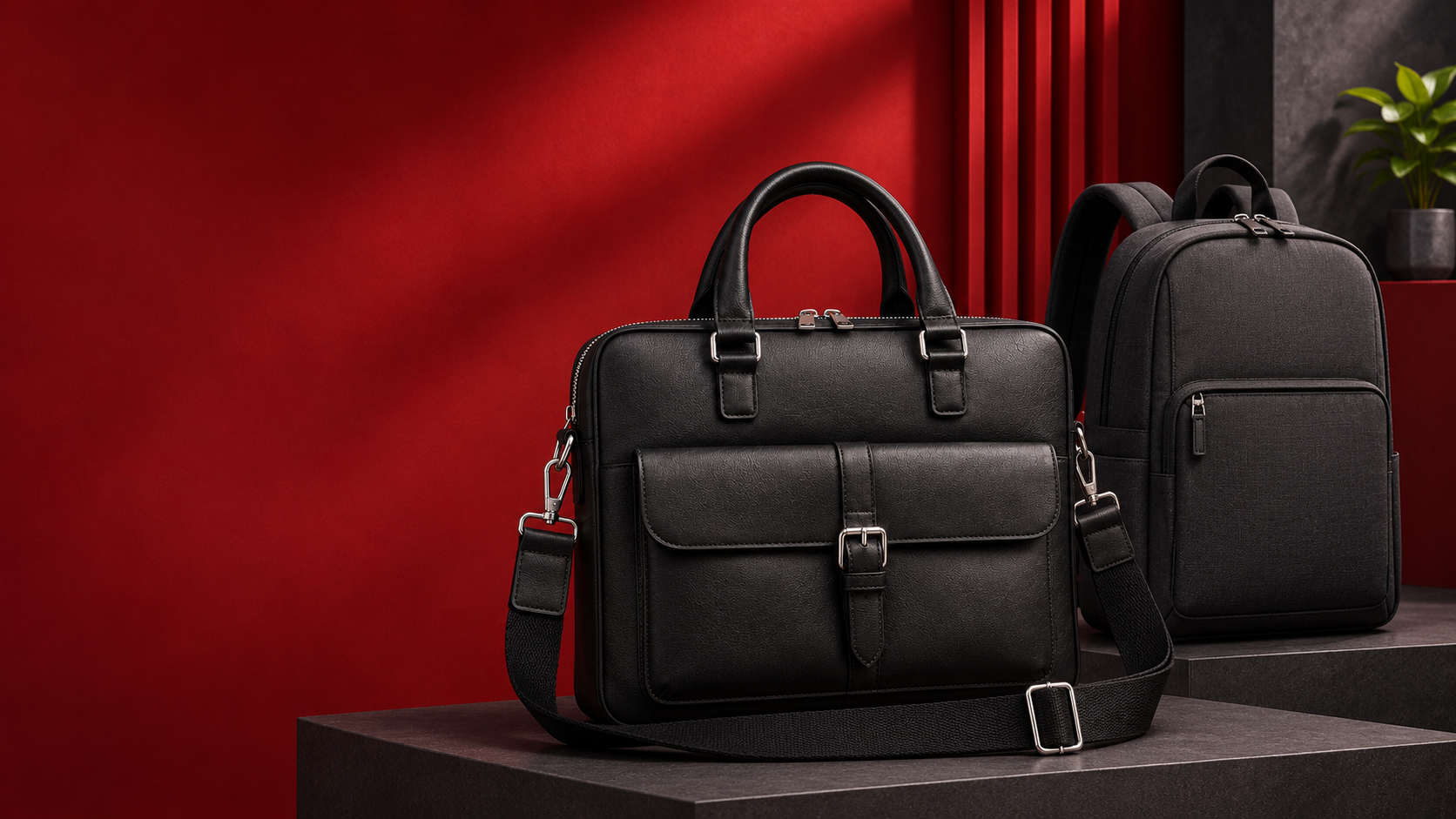
For an office commute in Pakistan, the right work bag is not always the one that looks smartest in a product photo. A leather briefcase keeps documents tidy and works naturally with formal meetings. A laptop backpack spreads a heavier load across both shoulders and gives you more room for a charger, bottle, notebook and a long day away from home.
Choose a briefcase if you usually carry a laptop, papers and a few essentials between the car, office and meetings. Choose a backpack if you walk, use public transport or carry heavier gear for longer. In either case, “original leather” is only the beginning: confirm the material, laptop fit, strap construction and exchange terms before you order.
The practical difference between a briefcase and a backpack
A briefcase is built around access and presentation. It usually has a flatter, more structured shape, a top handle and often a removable shoulder strap. You can set it beside a meeting table, reach for a document quickly and keep its profile relatively slim. Its limitation is simple: a full bag carried on one shoulder or in one hand becomes tiring sooner.
A laptop backpack is built around movement. Two shoulder straps distribute the weight more evenly, and the extra depth makes it easier to separate a laptop, charger, lunch, water bottle and a change of clothes. It can look just as professional when the shape is clean and the exterior is free of unnecessary straps or loud branding. The trade-off is that a larger backpack can feel less formal in a client-facing setting and takes longer to access when you are standing.
A five-minute decision guide
| If your day usually looks like this… | Better first choice | Why |
|---|---|---|
| Car, office, meeting room, client visit | Leather briefcase | Structured documents, quick access and a cleaner formal profile |
| Walking, public transport or a longer daily commute | Laptop backpack | More comfortable for a heavier, all-day carry |
| Laptop, charger, notebook and a few papers | Slim briefcase or compact backpack | Either works; decide by commute and dress code |
| Laptop, bottle, lunch, gym kit and accessories | Backpack | Extra depth and two straps are more practical |
| Formal presentations or interviews | Briefcase | Keeps papers flat and gives a composed first impression |
| One bag for work and occasional travel | Structured backpack or convertible design | Capacity is usually more valuable than a slim silhouette |
There is no wrong answer here. Plenty of people use a neat backpack every day and keep a briefcase for client meetings. The better question is not “which is more professional?” but “which one will I actually carry without overloading or leaving essentials behind?”
Laptop fit and daily capacity: measure before you decide
Do not buy a bag only because it says it is for a 15-inch or 16-inch laptop. Screen size is diagonal; bags depend on the device’s outside width, height and thickness. Measure your laptop in the protective sleeve you normally use, then compare those numbers with the bag’s internal compartment measurements.
- Measure your actual carry. Include charger, mouse, notebook and any file you take weekly.
- Leave room around the laptop. A compartment that forces the zip closed is not a good fit.
- Check the opening. A bag can be large enough yet awkward if the zip does not open wide enough to remove the device comfortably.
- Keep hard accessories apart. A charging brick pressed directly against a laptop is a poor arrangement; a separate section is better.
- Think about balance. In a backpack, heavier items should sit closer to your back. In a briefcase, a flat base and good handle anchors matter more as the load rises.
For a deeper office-bag checklist, see our guide to choosing a leather briefcase in Pakistan.
Original leather and “pure leather type”: the questions that matter
Searches for original leather briefcase Pakistan and pure leather type are understandable, but those phrases do not tell you exactly what a bag is made from. Ask for the outer material, the hide where available, the lining and the finish. A clear answer such as “cowhide outer with fabric lining” is more useful than a broad label alone.
Cowhide and buffalo leather are commonly selected for more structured bags because they can offer a firmer feel. Goatskin can be strong at a lighter weight, while lambskin is usually softer and may need gentler use. The best choice depends on whether you need a slim meeting bag, a daily workhorse or a lighter casual carry. Construction still matters: weak handle anchors, thin lining or poor zip fitting can shorten the useful life of any material.
Bonded or reconstituted material is not the same as a complete hide. The US Federal Trade Commission’s guidance says it should not be represented simply as leather. Treat that as a buyer principle wherever you shop: the seller should describe the material precisely, not leave you to guess.
Six checks before buying a work bag online
1. Check the carrying system
On a briefcase, inspect the top-handle patches, D-rings and detachable strap clips. On a backpack, inspect both shoulder straps, the top grab handle and the bottom seam. These are the parts that carry the weight.
2. Ask for internal measurements
External dimensions tell you how large the bag looks; internal dimensions tell you whether your laptop and sleeve will actually fit. Ask for both when they are not listed.
3. Look for a useful laptop section
A protected sleeve should keep the laptop separate from hard accessories. It does not need to be thickly padded to be useful, but it should be secure and sized for your device.
4. Inspect the zip, lining and base
Look for close views, not just a front hero image. A smooth-running zip, flat lining and reinforced base are more useful signals than decorative hardware.
5. Check the bag’s empty weight
Leather and hardware can add weight before you pack anything. If you commute far, ask for the empty weight and decide whether the comfort trade-off makes sense for your day.
6. Read the exchange policy before paying
Keep the product description and written answers from the seller. If the laptop fit, material or dimensions matter to you, confirm them before ordering and read what happens if the item differs from the listing.
Keeping a work bag useful for longer
The care basics are straightforward. Do not overfill a briefcase until the seams or zip bow outward. Empty a backpack occasionally so pens, chargers and dust do not wear into the lining. Wipe the exterior with a soft dry cloth, let wet leather dry naturally at room temperature and avoid drying it with direct heat.
In humid weather, give leather airflow rather than sealing it in plastic. The Canadian Conservation Institute notes that relative humidity above 65% favours mould growth on leather. When storing a briefcase, fill it lightly with clean paper so it keeps its shape; for a backpack, loosen the straps and store it somewhere dry and ventilated.
Frequently asked questions
Is a leather briefcase better than a backpack for work?
A briefcase is often better for a lighter, formal, meeting-focused carry. A backpack is usually better for a longer commute or a heavier load. The right answer depends on your workday, not on a single style rule.
Can a backpack look professional in an office?
Yes. A compact backpack with a simple shape, restrained hardware and no oversized branding can look completely appropriate in modern offices. Choose a briefcase when you need a flatter, more formal document-focused carry.
Which pure leather type is best for a laptop bag?
Cowhide and buffalo leather are often useful for structured laptop bags; goatskin can reduce weight while remaining strong. The lining, sleeve, handle or straps and base construction matter just as much as the hide.
Should I carry a heavy laptop in a briefcase?
You can, if the briefcase is designed for it and you do not carry it far. For a long walk or commute with a heavy laptop and accessories, a backpack usually spreads the load more comfortably.
How do I know whether an online leather bag is original?
Ask for a specific material description, inspect photos of the seams, edges, lining and hardware, compare internal measurements with your device, and read the exchange terms. One label or one photograph is not enough evidence on its own.
Choose for the day you actually have
The best work bag is the one that supports your routine without becoming a burden. Choose a briefcase for focused, formal carry; choose a backpack for longer movement and more equipment. Then choose the material and construction with the same care. Browse the LeatherCulture collection for current pieces or contact the team for product details.