
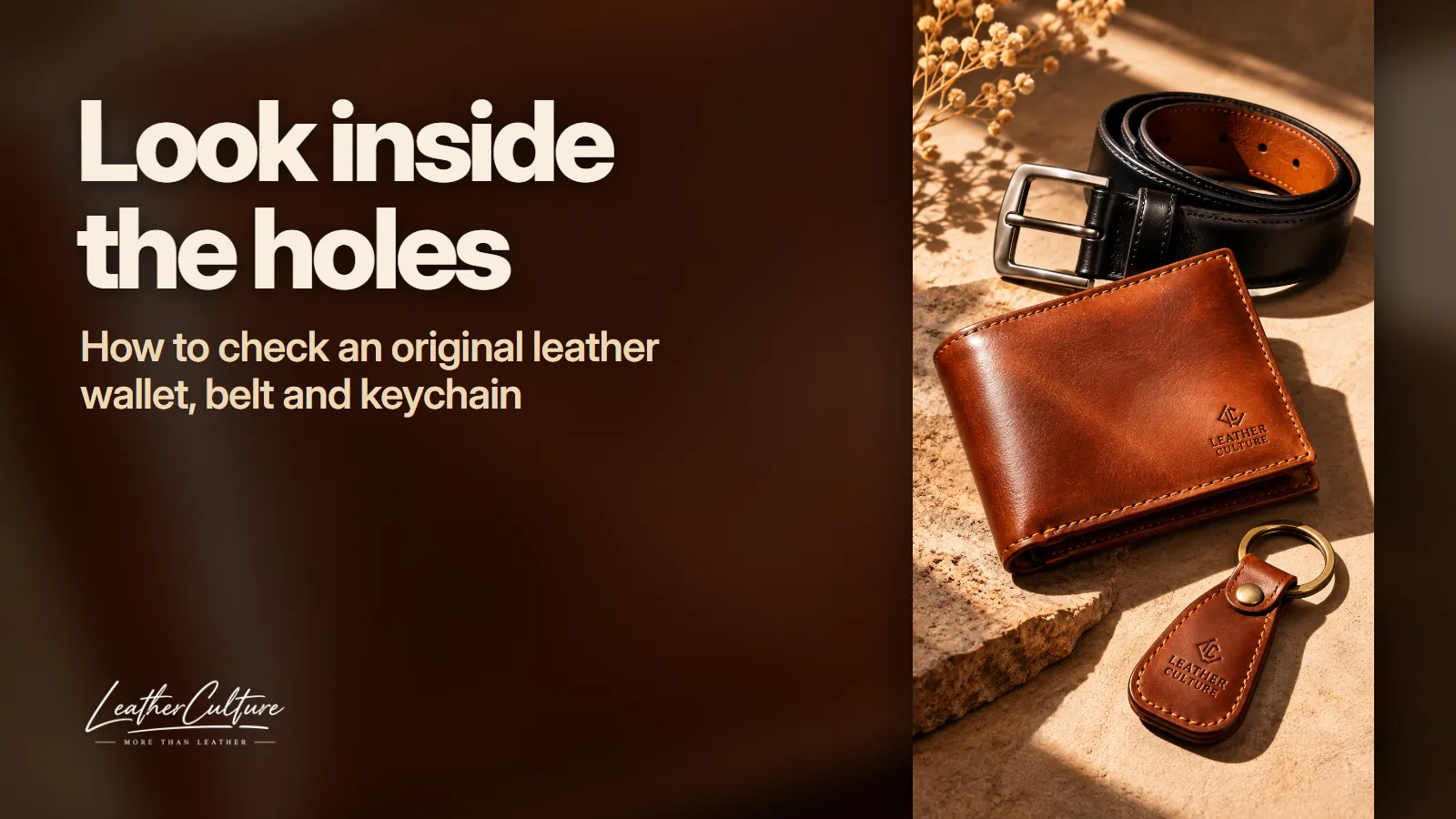
Small leather goods are where the word "leather" works hardest and proves least. A wallet's edges are painted, a belt's core is hidden between two faces, and a keychain is too cheap for anyone to ask questions about. In 2024 a leatherworker on a craft forum cut open a belt sold as genuine leather and found six layers of fabric inside, with no leather anywhere.
You do not need a knife to avoid that belt. You need to know where to look. On 6 November 2026 we read the wallet and belt listings on OLX Pakistan, and gathered the searches Pakistanis actually make, such as "how to check original leather wallet" and "pure leather belt price in Pakistan". This guide turns both into seven checks to run at a counter or request over chat.
An original leather belt shows the same fibrous material all the way through when you look inside a hole or at the cut tip, while a fake shows a sandwich of fabric, board or foam. On a wallet, check the fold, the edges and the stitching. Then ask for the pure leather type: a thick cow or buffalo hide suits a belt, and a thinner cow or goat suits a wallet. Of the 142 listings we read, half claimed pure or original leather, but only 16 named one animal and just 2 belts said they were cut from a single piece.
What 142 wallet and belt listings told buyers
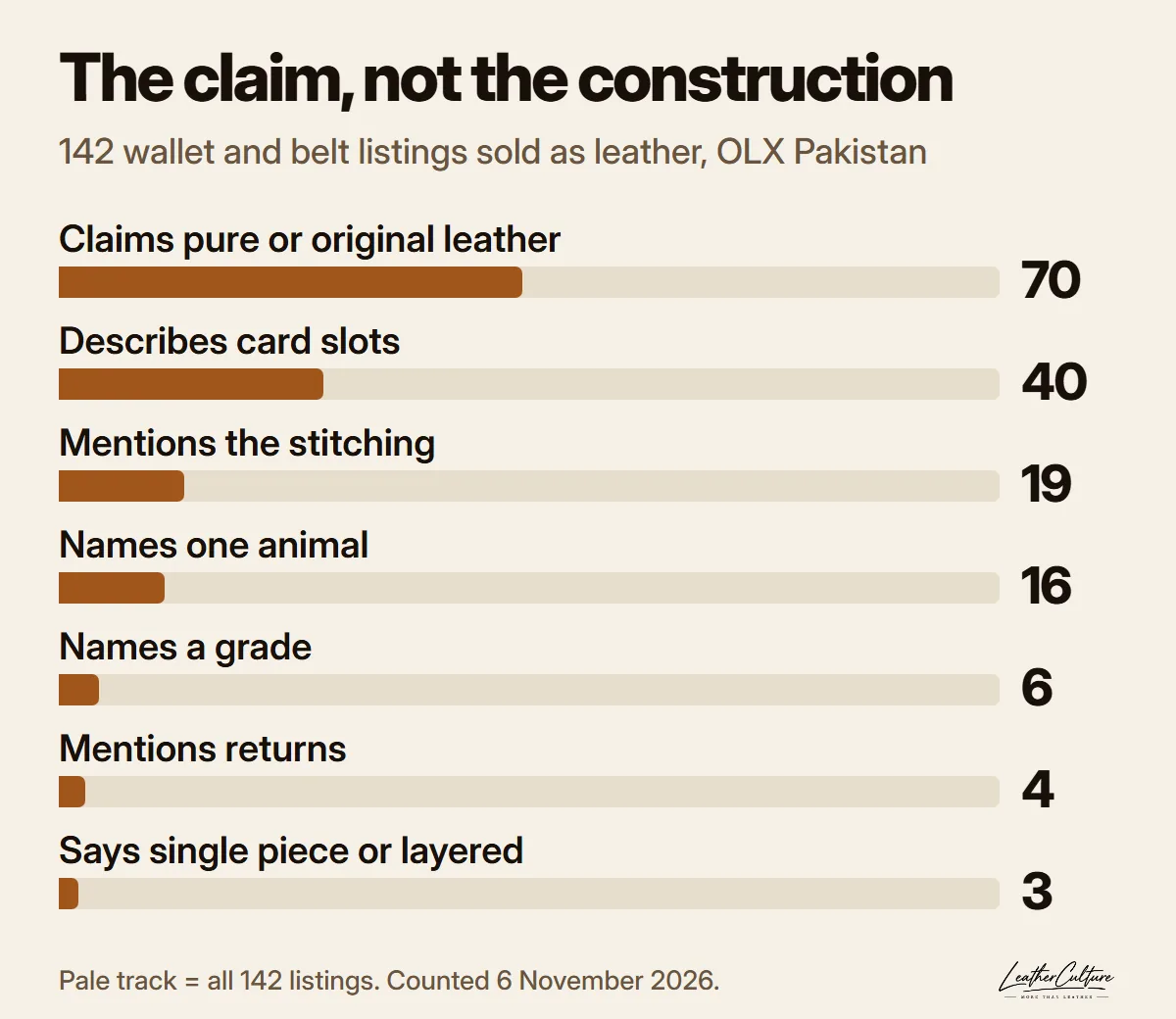
We ran seven plain phrases through OLX across Pakistan, Punjab, Sindh and five large cities: "leather wallet", "leather belt", "leather card holder" and close variants, with no "pure" or "original" in the search. That surfaced 717 listings, most of them phone covers and other bags. We kept 174 that were wallets, card holders or belts with "leather" in the title, then read every description. Thirty-two said they were PU, faux or another synthetic, which left 142 sold as leather: 110 wallets and 32 belts.
| Disclosure | Listings |
|---|---|
| Used pure, original, genuine or real about the leather | 70 |
| Described card slots or pockets | 40 |
| Mentioned the stitching | 19 |
| Named one animal | 16 |
| Gave a belt size or width | 6 of 32 belts |
| Named a grade, such as full grain | 6 |
| Offered a "guarantee" or "warranty" | 6 |
| Mentioned a return or exchange | 4 |
| Said whether the piece was single or layered | 3 |
Half the listings made a claim, and most stopped there. Seventy used a word like pure or original, yet 58 of them gave no animal and no grade. Cow was the animal named most often, followed by a few crocodile and camel claims that deserve extra questions.
Belts said the least about the thing that matters most. Only 2 of the 32 belt listings said the strap was cut from one piece of leather. None explained what sat between the two faces, which is exactly where a cheap belt hides its filler.
Wallets described pockets, not materials. Forty wallet listings counted the card slots, which is useful, but very few said how the slots were built or what the lining was. OLX is one slice of the market and a shop may know more than its listing says. Read these figures as what a buyer sees before asking, and see how they were counted.
The belt hole test
A belt is a strip under constant tension, and its holes are where that tension concentrates. That makes them the best window into whether a belt is original leather and how it was built. Look into a hole from the side, or at the cut tip of the strap, and you will usually see one of three things.
- One layer, all the way through. A single thick strip of hide shows the same fibrous material from face to back, sometimes a little paler in the middle. This is the classic single-piece belt.
- Two leather layers, stitched and glued. A thin line runs through the middle where two leathers meet, often with stitching along both edges. Belt makers list this laminated build as a normal option, so it is not a fake. Ask whether both layers are leather, because the back layer is sometimes a split or a fibreboard.
- A sandwich with a different core. You see a layer of fabric, card-like board, foam or a smooth plastic between thin outer skins. The forum belt mentioned above had six layers of fabric and synthetic faces. A belt maker, Hanks Belts, says belts made from processed leather scraps tend to crack at the holes, and that is what this construction does.
Then bend the belt gently through a hole. Leather creases and recovers. A coated sandwich often whitens, cracks or shows the layers separating at the hole's edge. Do this before the buckle is fitted to your size, because some shops cut and punch to order.
The same idea works on a wallet. Look at an edge where several layers meet: there should be leather on each face, not a printed sheet over cardboard. If an edge is heavily painted, the inside of a card slot or the fold is often easier to read. Our real or faux checks cover the basic grain and cut-edge tests.
Seven checks for a wallet, belt and keychain
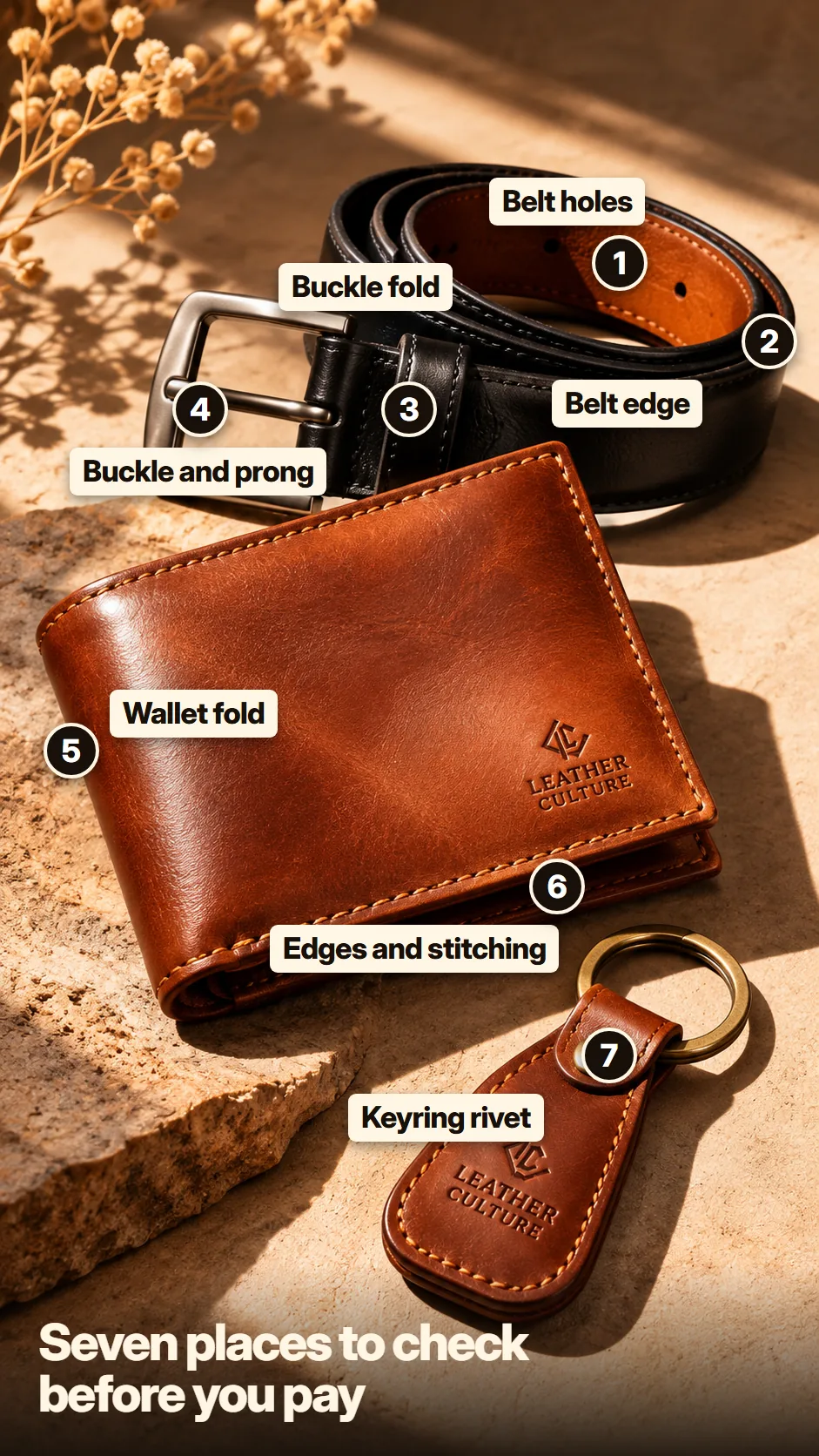
1. Belt holes
Do the hole test above. Clean, round holes with fibres visible inside are a good sign. Holes that look melted, glossy or layered suggest a coated or bonded strap.
2. Belt edge
Run a fingernail along the edge. A sealed, smooth edge is fine, and so is a slightly rough, burnished one. Watch for an edge coating that is already lifting, or a visible gap where two layers are separating, especially near the tip.
3. Buckle fold
Where the strap folds around the buckle bar, it is either stitched or held with screws. Screws let you change the buckle later, which is useful, as long as they are tight and the leather around them is not tearing. A stitched fold should have even stitches and no cracks along the crease.
4. Buckle and prong
The prong should sit flat in a hole without twisting. Check the plating near moving parts, where it wears first, and the inside of the buckle frame for rough casting marks. A buckle can outlast the strap or fail long before it, so treat it as a separate part when comparing prices.
5. Wallet fold
A bifold bends at the same line thousands of times. Open and close the wallet several times. Leather softens along the fold, while a coated material starts to show fine cracks or a pale line where the surface is giving up.
6. Edges and stitching
Look along the outer edges and between the card slots. Stitches should be even and tight, with no gaps where layers have come apart. Edge paint is meant to wear over time, so some scuffing is normal. Peeling at the edge on a new wallet is not.
7. Keyring rivet
A keychain carries keys, which are heavy for their size. The tab should be riveted through both layers, with the rivet sitting flat on both sides. A tab that is only glued around the ring will open in your pocket.
Which pure leather type suits each piece?
A belt and a wallet ask opposite things of leather. A belt needs thickness and resistance to stretching. A wallet needs to be thin, flexible and still hold its shape. How the hides themselves differ is covered in our pure leather types guide. For small goods, it comes down to this.
| Piece | What it needs | Good choice | Be careful with |
|---|---|---|---|
| Belt | Thickness, no stretch at the holes | One thick strip of cow or buffalo, full grain if possible | Thin layers around an unknown core |
| Bifold wallet | A fold that survives daily bending | Thinner cow or goat | Heavily coated surfaces on the fold |
| Card holder | Slim build, slots that grip | Firm, thin cow or goat | Very soft leathers that stretch quickly |
| Keychain | A strong tab at the ring | Thick cow, riveted | Glued tabs with no rivet |
Typical men's belts are about 3.5 to 4.5 mm thick, according to one manufacturing guide. A very thin strap at a premium price deserves a question. Sheep leather is lovely in a wallet's lining but wears fast on the outside of something carried every day. Crocodile and other exotic claims at bazaar prices should be treated as embossed patterns until proved otherwise.
Getting the belt size and wallet size right
Only 6 of the 32 belt listings gave any size or width, so expect to work it out yourself. Take a belt you already wear, lay it flat, and run a tape from the buckle fold to your usual hole. That length is a better guide than your trouser size, which varies by brand. Belt makers measure in slightly different ways, so ask the seller how theirs is measured.
- Land on the centre hole. That leaves spare holes either way for heavier clothes or a change in weight.
- Check the width. Formal trousers usually take a narrower belt than jeans. Measure your trouser loops if you are not sure.
- For a wallet, count your cards. Buy for the cards you carry now plus one or two. A wallet that is stuffed from day one will stretch its slots and split its fold.
Wallet and belt prices in Pakistan
| Group | Priced listings | Midpoint | Middle 50% |
|---|---|---|---|
| Wallets sold as leather | 109 | Rs 1,499 | Rs 1,000 to Rs 2,500 |
| Wallets claiming pure or original | 54 | Rs 1,975 | Rs 1,000 to Rs 3,500 |
| Wallets admitting a synthetic | 21 | Rs 1,099 | Rs 549 to Rs 1,499 |
| Belts sold as leather | 32 | Rs 1,791 | Rs 1,200 to Rs 2,274 |
- Cheap "leather" overlaps with PU. A quarter of wallets sold as leather asked Rs 1,000 or less, below the Rs 1,099 midpoint for wallets that openly said they were synthetic.
- A claim adds a few hundred rupees. Wallets claiming pure or original had a midpoint of Rs 1,975, against Rs 1,499 for all leather wallets. The claim itself proves nothing.
- Synthetic belts were cheaper still, but few. Only 10 belt listings admitted a synthetic, too few for a reliable figure, and most asked under Rs 1,000.
None of these prices were checked against the actual material, so read them as context only. The habit from our jacket price guide applies here too: compare whole offers, not the number in the title.
Buying a wallet or belt as a gift
People in Pakistan search for wallet and belt gifts, including ready-made gift sets. A set can be good value, but each piece still has to pass its own checks. A beautiful box does not make a layered belt any stronger.
- For a belt, borrow one he already wears and measure it, as described above. If that is impossible, choose a style with a screw-fitted buckle so it can be shortened.
- For a wallet, notice how many cards and how much cash he carries. A slim card holder suits someone who pays mostly by card, while a bifold suits cash.
- Ask about exchanges before paying, since sizes are the most common reason to return a belt.
Our gift guide for him has more ideas on timing and presentation.
Questions to send a seller
When you cannot hold the piece, ask for what you would have checked yourself. This message works on WhatsApp, Instagram or OLX chat.
Salam. Before I order, could you tell me: (1) which animal and layer this is made from, such as full-grain cow; (2) for the belt, is the strap one piece of leather, or layers, and what is in the middle; (3) a close photo looking into one of the belt holes, or at the edge of the wallet; (4) the belt width, and its length from the buckle fold to the middle hole; (5) is the buckle stitched or screwed on; (6) can I swap or send it back if it differs from the photos, and who covers delivery?
Salam. Order se pehle zara bata dein: (1) yeh kis janwar ke chamre aur kaunsi layer ka bana hai, maslan full-grain gaaye; (2) belt ka patta ek hi tukde ka hai ya layers ka, aur beech mein kya hai; (3) belt ke kisi surakh ke andar ki, ya wallet ke kinare ki close photo; (4) belt ki chaurai, aur buckle ke mor se beech wale surakh tak lambai; (5) buckle silai se laga hai ya pech se; (6) agar cheez bataye gaye jaisi na nikli to exchange ya wapsi ho sakti hai, aur delivery ka kharcha kaun dega?
Ordering online more often? Our online checklist for original leather covers photos and payment in more detail.
Wallet aur belt asli hai ya nahi?
Agar aap Google par "leather wallet ki pehchan" ya "asli leather belt" dhoond rahe hain, to sab se pehle belt ke surakh ke andar jhank kar dekhein. Asli ek tukde wali belt mein upar se neeche tak ek jaisa reshedar chamra nazar aata hai. Nakli belt mein beech mein kapra, gatta ya foam ki layer hoti hai.
- Belt ko surakh par halka sa moriye. Asli chamra moorta hai aur wapas aa jata hai, jabke coated belt par safed lakeerein ya daraarein aati hain.
- Belt ke kinare par nakhun pheriye. Koi layer uthti nazar aaye to sawal karein.
- Wallet ko kai baar khol band karein. Mor par daraar ya phatti hui chamak achi nishani nahi.
- Wallet ke kinare aur card slots ke beech silai barabar honi chahiye.
- Keychain ka tab rivet se juda ho, sirf gond se nahi.
Phir seller se chamre ka janwar aur layer poochein. Hamare sample ki 142 listings mein sirf 16 mein kisi ek janwar ka zikr mila, aur sirf 2 belts ne patte ke ek tukde hone ki baat ki.
LeatherCulture and small leather goods
Wallets, belts and keychains are not part of our range yet. Right now we sell leather jackets, with accessories to follow. The pieces in these photos are designs in planning, so this guide says nothing about what they are made of. Once they launch, put them through the same seven checks.
How the listings were counted
- Search demand. The questions answered here are the ones Google suggests to people in Pakistan as they type. Suggestions reveal wording, not volume.
- Which listings. The seven phrases covered eight OLX locations, from the national page down to individual cities. To qualify, an item needed "leather" plus wallet, card holder or belt in its name and had to be filed as fashion. Bags, watches, children's items and belt-making tools did not qualify, and every qualifying description was read.
- What counted as a claim. Pure, original, genuine or real only counted when attached to the hide or the item itself. A listing that said "not PU" was not counted as synthetic. No item was handled or tested, so every figure reflects the seller's own words.
- Prices. Asks below Rs 300 or above Rs 80,000 were left out as placeholders. Any group with under 20 prices is described in words rather than given a midpoint.
- Limits. One marketplace on one day is a snapshot, not a census. Some sellers post similar text more than once, and counting each text once gave the same picture. No seller is named here.
Questions buyers ask about leather wallets and belts
How do I know if a leather belt is original?
Look inside one of the holes or at the cut tip of the strap. A single-piece leather belt shows the same fibrous material all the way through. Layers of fabric, board or foam in the middle point to a bonded or synthetic belt. Then bend the belt at a hole: leather creases and recovers, while coatings tend to crack or whiten.
How do I know if a leather wallet is original?
Open and close it several times to test the fold, look at the edges where layers meet, and check the inside of a card slot. Leather softens along the fold and shows fibres at a cut edge, while a coated material cracks at the fold or shows fabric underneath.
Is a two-layer belt fake?
Not necessarily. Two leather layers glued and stitched together is a normal way to make a belt. The question is what the layers are. Ask whether both are leather, and whether anything else sits between them.
What is a bonded leather belt?
It is a sheet of shredded leather fibres held together with a binder, usually finished with a coating. In the Leather Working Group's definitions this is leather fibre board, a separate category from leather itself. Belts made this way tend to crack at the holes.
What leather makes the best belt?
A thick, single piece of cow or buffalo hide, ideally full grain, gives the best resistance to stretching and cracking. Men's belts are typically about 3.5 to 4.5 mm thick.
What leather makes the best wallet?
A thinner cow or goat leather suits most wallets, because it bends at the fold without cracking and still holds its shape. Very soft leathers look good at first but can stretch at the card slots.
How much does an original leather wallet cost in Pakistan?
Wallets in our sample that claimed pure or original leather sat around Rs 1,975, and half of them asked between Rs 1,000 and Rs 3,500. These asks were not checked against the material, so compare the actual pieces.
What is the price of a leather belt in Pakistan?
Belts sold as leather sat around Rs 1,791 in our sample of 32, and half of them asked between Rs 1,200 and Rs 2,274. Construction matters more than the price, so do the hole test before you pay.
How do I find my belt size?
Take a belt you already wear and measure from the buckle fold to your usual hole. Brands measure differently, so ask how the seller does it, and pick the size that lands you on the centre hole.
Do I need an RFID-blocking wallet?
Only one listing in our sample mentioned RFID. It may give some peace of mind if you carry contactless cards, but it has nothing to do with whether the wallet is leather. Judge the leather and the construction separately.
Does LeatherCulture sell wallets and belts?
Not at the moment. The shop sells jackets today, and small leather goods come later. The items photographed here are designs in planning.
The small pieces deserve the same questions
A wallet or belt is cheap enough that most people never ask what it is made of, and that is exactly why the word "leather" is used so loosely on them. Look inside a hole, bend the fold and check the edges. Thirty seconds is usually enough to tell a piece that will last from one that only looks the part.