
Searches for original leather bags in Pakistan or pure leather bags in Pakistan are usually asking one simple question: “Will this bag feel and wear like real hide, or will it look good for a month and then peel?” Online photos alone cannot settle that question. A better approach is to look for several small pieces of evidence before you place the order.
A trustworthy leather listing says what the material is, shows close photographs instead of hiding the surface, gives practical dimensions, and makes it easy to ask questions. Natural grain, neatly finished edges, a sound lining and sturdy hardware support the case; a vague “pure leather” label by itself does not.
“Original leather” is a buyer’s search term, not a leather grade
In Pakistan, shoppers commonly say original leather, pure leather, genuine leather and real leather when they want an animal hide rather than a synthetic lookalike. Those phrases are useful for finding products, but they do not tell you the complete story. They do not identify the hide, the layer of the hide, how the surface was finished, or how the bag was constructed.
The most helpful product page is more specific. It might say cowhide, buffalo leather, goatskin, lambskin, suede, or leather with a fabric lining. It may also explain whether the leather has a natural, smooth, pebbled or corrected surface. Specificity lets you compare two bags honestly. A loose label does not.
One distinction matters especially. Bonded or reconstituted leather is made from leather fibres or scraps mixed with binders and applied to a backing; it is not a complete hide. The US Federal Trade Commission’s leather-product guidance says this type of material should not be represented, directly or by implication, as plain leather. That is not a Pakistan-specific shopping rule, but it is a useful reminder to ask for a clear material description rather than relying on a headline.
If you are comparing a real hide with a synthetic alternative, see our straightforward guide to real leather versus faux leather. It explains how the two materials tend to age differently.
The seven checks before you order a leather bag online
1. Read the material line before you read the marketing line
Start with the plainest question: what, exactly, is the outer material? Look for a direct answer in the specification, description or FAQ. “Leather bag” is less useful than “cowhide outer with polyester lining,” for example. If the listing does not say, send the seller a short message: “Is the outside a complete animal hide, and which hide is it?” A seller who knows the product should be able to answer without avoiding the question.
2. Look for natural variation, not a perfectly repeated pattern
Natural leather has pores, creases and small changes in grain. They should be subtle, not theatrical. In close photographs, the pattern should shift across panels rather than repeat like wallpaper. A uniform stamped grain is not automatic proof of a synthetic material; corrected leather can be embossed too. It is simply a cue to ask for more detail before deciding.
3. Zoom in on the cut edges and seams
The edge where a strap, pocket or flap is cut can reveal a lot. A finished leather edge is usually painted, folded, burnished or neatly bound. The work should look even, with no glue blobs, fraying fabric or obvious lifting. Then follow the stitching: it should be straight, consistent and secure around stress points such as strap anchors and zip ends.
4. Treat lining and construction as part of the purchase
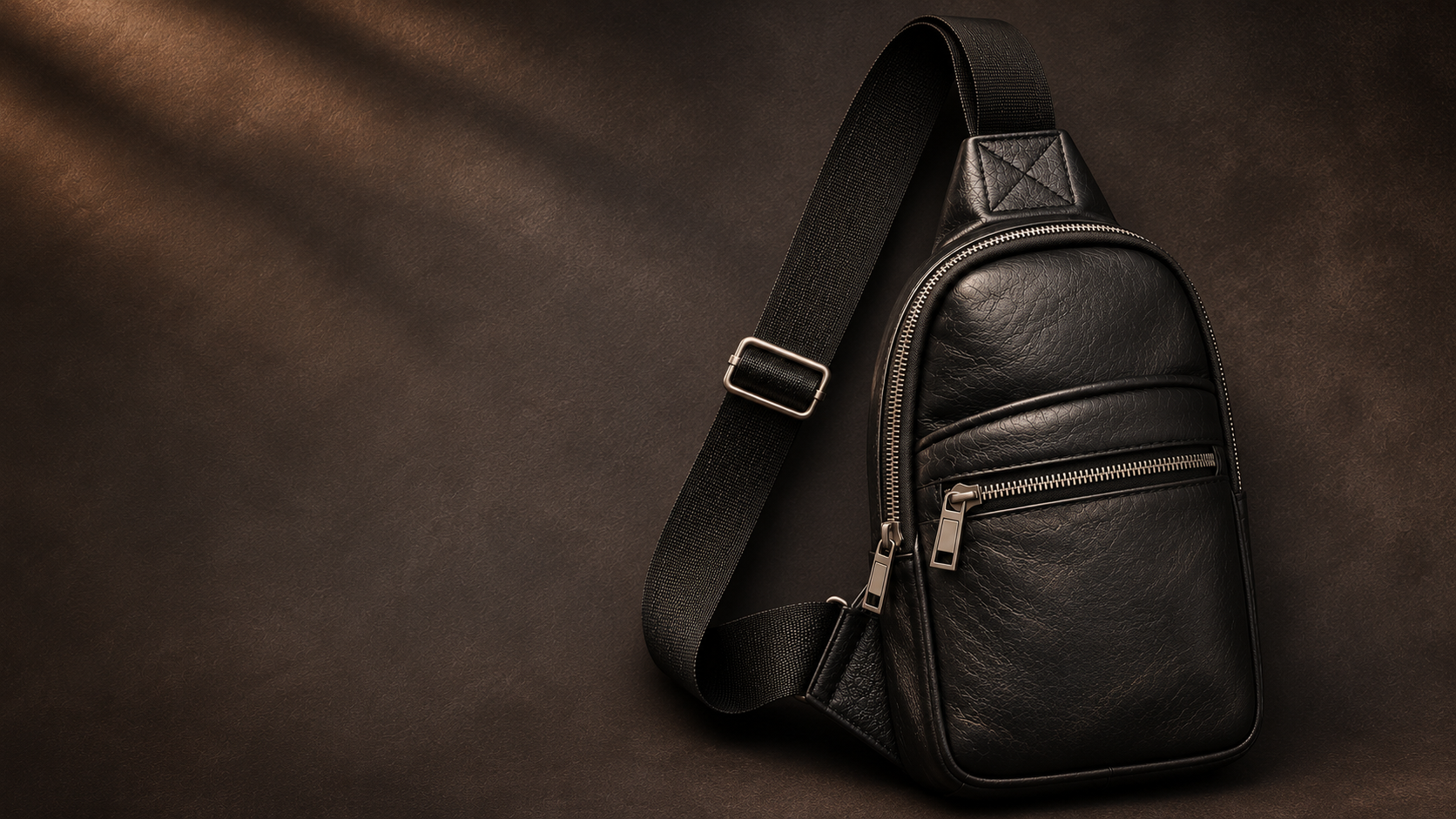
A good outer material cannot rescue a poorly built bag. Check whether the lining lies flat, whether inside pockets have clean stitching, and whether the base has enough structure for the way you will carry it. For a sling bag, the strap webbing, buckle and anchor points matter as much as the leather body because they take the day-to-day load.
5. Check the hardware in close-up
Ask for a close photo of the zip pull, zip teeth, D-rings, buckles and snaps. You are looking for a clean finish, secure attachment and hardware that suits the weight of the bag. A zip should move smoothly in a short product video; a close-up photo cannot prove that, so it is reasonable to ask.
6. Use dimensions to judge usefulness, not just looks
Before ordering an original leather sling bag in Pakistan, compare the listed height, width and depth with the things you carry every day. Will your phone fit? A small wallet? Sunglasses? A power bank? Measurements prevent the most common online-shopping disappointment: a bag that is beautiful but too small for its job.
7. Check the seller’s evidence and policy
Clear front, back, side and interior photos suggest that the seller wants you to see the whole product. Read the exchange or return terms before paying, keep your order confirmation, and use a payment method you are comfortable with. If cash on delivery is offered, understand the courier and inspection rules in advance; do not assume that every parcel can be opened before payment.
| What to check | A useful positive sign | Question to ask if it is unclear |
|---|---|---|
| Material | Specific hide or clear composition | “What is the outer material?” |
| Surface | Close, well-lit photos from more than one angle | “Can you share a close-up of the grain?” |
| Edges and stitching | Even finishing and straight, secure seams | “Can I see the strap anchor and side edge?” |
| Hardware | Clear photos or a short working-zip video | “What metal is used for the zip and buckle?” |
| Capacity | Height, width and depth are listed | “Will it fit a phone measuring ___ cm?” |
| After-sales support | Written exchange/return information | “What happens if the size or item differs from the listing?” |
How to assess a leather bag from photographs
Most people cannot touch a bag before ordering online, so the product page has to do more work. One polished hero image is not enough. Look for a small set of practical photographs: front, back, side, interior, strap attachment, hardware and a close detail of the leather. Different lighting is useful too, because a highly coated surface can look very different under a bright studio lamp and ordinary indoor light.
Do not use a “smell test,” flame test or water test on a new bag. They are not reliable online checks, and the latter two can damage a product you may need to return. Evidence from the seller, honest specifications and a clear policy are safer than internet tricks.
When a listing says pure leather bag Pakistan, do not treat the phrase as a guarantee or a warning by itself. Use it as the start of your research. The stronger evidence is a complete material statement, enough close photography to inspect the construction, and helpful answers to normal buyer questions.
What a low or high price actually tells you
Price can be a clue, but it is never a full quality test. Leather type and thickness, the amount of material used, lining, zips, hardware, pattern cutting, labour, packaging and delivery all affect the final figure. A high price does not prove a bag is better. An unusually low price does not prove it is fake either, but it should make you slow down and ask what is being offered.
Compare like with like. A small leather cardholder should not be measured against a structured travel bag. Likewise, a minimal sling bag with a fabric strap will have different construction costs from a fully leather-lined satchel. Make a short comparison list: material, dimensions, lining, hardware, photographs, delivery charges and exchange policy. That list is more useful than sorting only by price.
Leather bags in Pakistan: buying smart and caring for them well
Pakistan’s climate changes how you use and store a bag. In warmer, humid months, do not leave leather sealed in a plastic bag or pressed against a damp wall. Airflow matters. The Canadian Conservation Institute notes that relative humidity above 65% favours mould growth on leather, skin and fur. After getting caught in rain, empty the bag, blot the surface with a soft cloth and let it dry naturally at room temperature. Keep it away from direct sun, radiators and hairdryers.
For everyday maintenance, remove dust with a dry microfiber cloth and keep the bag lightly stuffed with clean paper when it is not in use, so it holds its shape. Test any conditioner on a hidden area first. A little is enough; over-conditioning can leave residue and darken some finishes.
These habits are useful whether you choose a leather sling bag, wallet, belt or jacket. For a wider guide to judging leather quality, fit and care, read how to choose leather in Pakistan.
Frequently asked questions
Is “pure leather” the same as full-grain leather?
No. “Pure leather” is commonly used in shopping searches, while full-grain describes a particular type of leather surface: the grain layer has been left intact. Ask for the actual hide and finish if that difference matters to you.
How can I identify original leather from an online photo?
You cannot confirm it from one photo alone. Look for several close views, a precise material description, details of the edges, lining and hardware, plus a seller who answers direct questions clearly.
Do original leather bags crack or peel?
Natural leather can dry, scratch or develop creases, especially without care. Peeling in sheets is more often associated with a surface coating or synthetic material, but the exact cause depends on the bag’s construction and finish.
Which leather bag colour is easiest to use every day?
Black is usually the simplest choice because it works with most outfits and shows small marks less readily. Brown develops a warmer, more visible patina. Choose the colour that fits the clothes and shoes you already wear.
What should I ask a seller before buying a leather sling bag in Pakistan?
Ask what the outer material is, request the measurements, confirm what fits inside, check the exchange terms and ask for close photos or a short video of the zip and strap attachments if those details are not already visible.
Buy with evidence, then enjoy the bag
The best original leather bag is not simply the one with the strongest label. It is the one whose material, construction and capacity have been shown clearly enough for you to choose with confidence. Take two extra minutes to check the details, keep the product information, and choose a design you will actually carry often. When you are ready to explore understated everyday pieces, visit the LeatherCulture shop.