
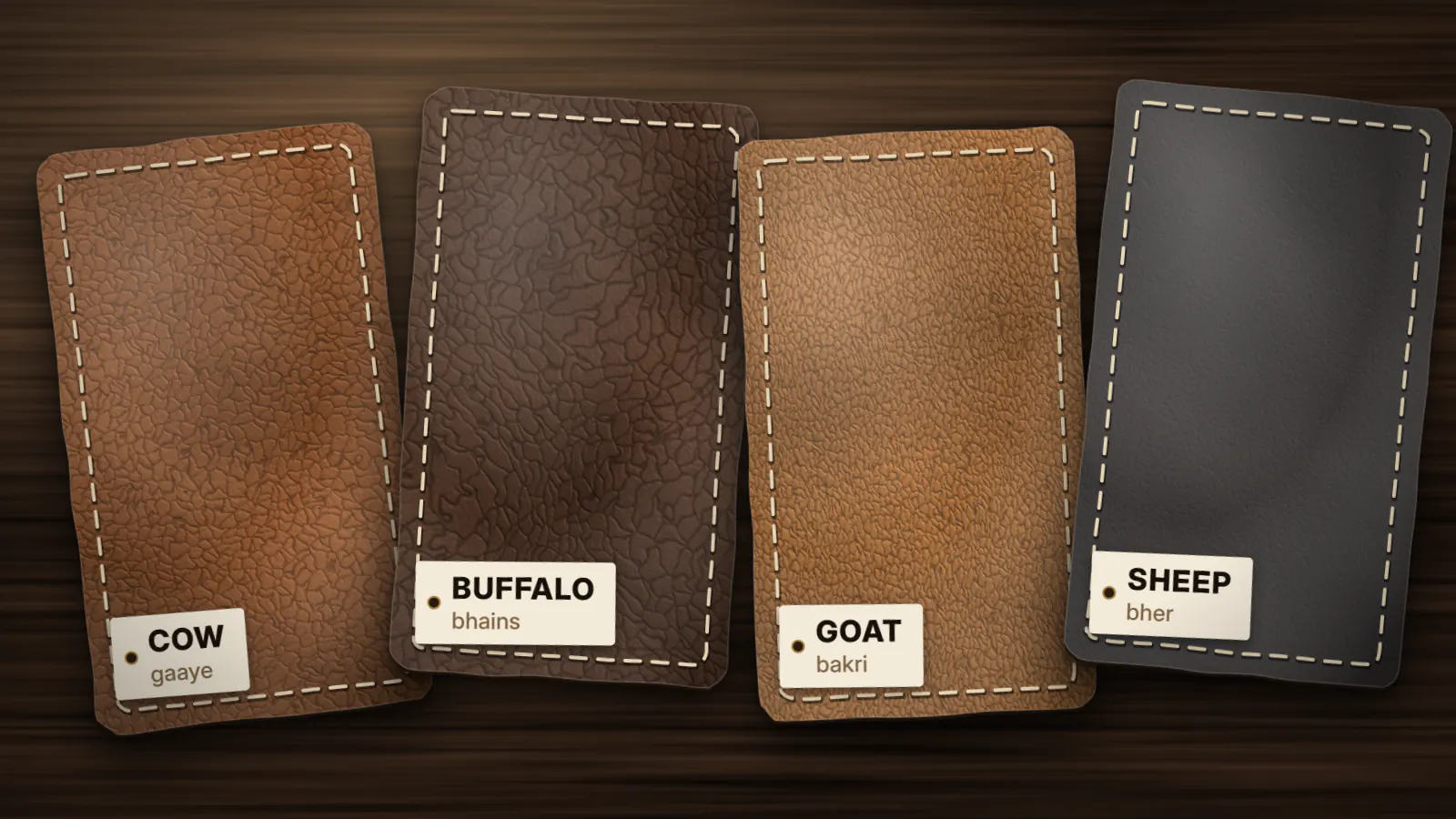
Search for a leather jacket, wallet or pair of shoes in Pakistan and the same promises keep appearing: pure leather, original leather, 100% genuine. Each phrase is meant to end the conversation. None of them tells you whether you are paying for soft sheep nappa, a firm buffed cowhide or a suede split, and those three will feel, wear and age in completely different ways.
This guide is organised around what shoppers here actually type. We pulled the questions below from Google's search suggestions for Pakistan on 1 November 2026, including Roman Urdu ones such as "asli leather ki pehchan", then answered them with trade definitions instead of shop talk.
"Pure leather" is a shop phrase, not a grade. The real pure leather types come from three separate choices: the animal (cow, buffalo, goat or sheep), the layer (full grain, corrected grain or split) and the finish (aniline, semi-aniline or pigmented). A seller who knows the product can name all three. As a starting point, cow and buffalo suit hard use, goat suits light everyday pieces, and sheep suits soft jackets worn with some care.
What is pure leather made of, and what does original leather mean?
Pure leather is animal hide or skin that has been tanned so it will not rot. That is the whole of the promise. No official grade is called "pure", and the Leather Working Group's list of trade definitions, which draws on ISO, UNECE and European wording, never uses the phrases "pure leather", "original leather" or "genuine leather".
What that list does define is leather itself: a hide or skin of animal origin, tanned, with its natural fibre structure more or less intact and any surface coating no thicker than 0.15 mm. Two details in that definition are worth remembering when you shop:
- Shredded leather stops being leather. Break a hide into fibres or powder, press it back into sheets, and the definition no longer applies, even if most of the sheet began as hide. US Federal Trade Commission guidance takes the same line on bonded material.
- No grain means a qualifier. Once the grain layer has been removed completely, the word leather is supposed to travel with a qualifier, as in "split leather" or "suede leather".
These are international and US reference points rather than Pakistani law, but they are the clearest benchmark a shopper has. So the fair reading of "pure leather", "original leather" or "asli leather" is simple: the seller is claiming this is real hide, not PU or rexine. That claim is useful, and you can hold a seller to it. It just says nothing yet about quality.
What are the types of pure leather? Use the label test
Most lists of leather types, including many written for shoppers in Pakistan, throw animals, layers and finishes into a single ranking. That is why they confuse people, and why "is goat better than full grain?" is not a real question. Goat is an animal and full grain is a layer, so one jacket can be both. Treat them as three parts of one description.
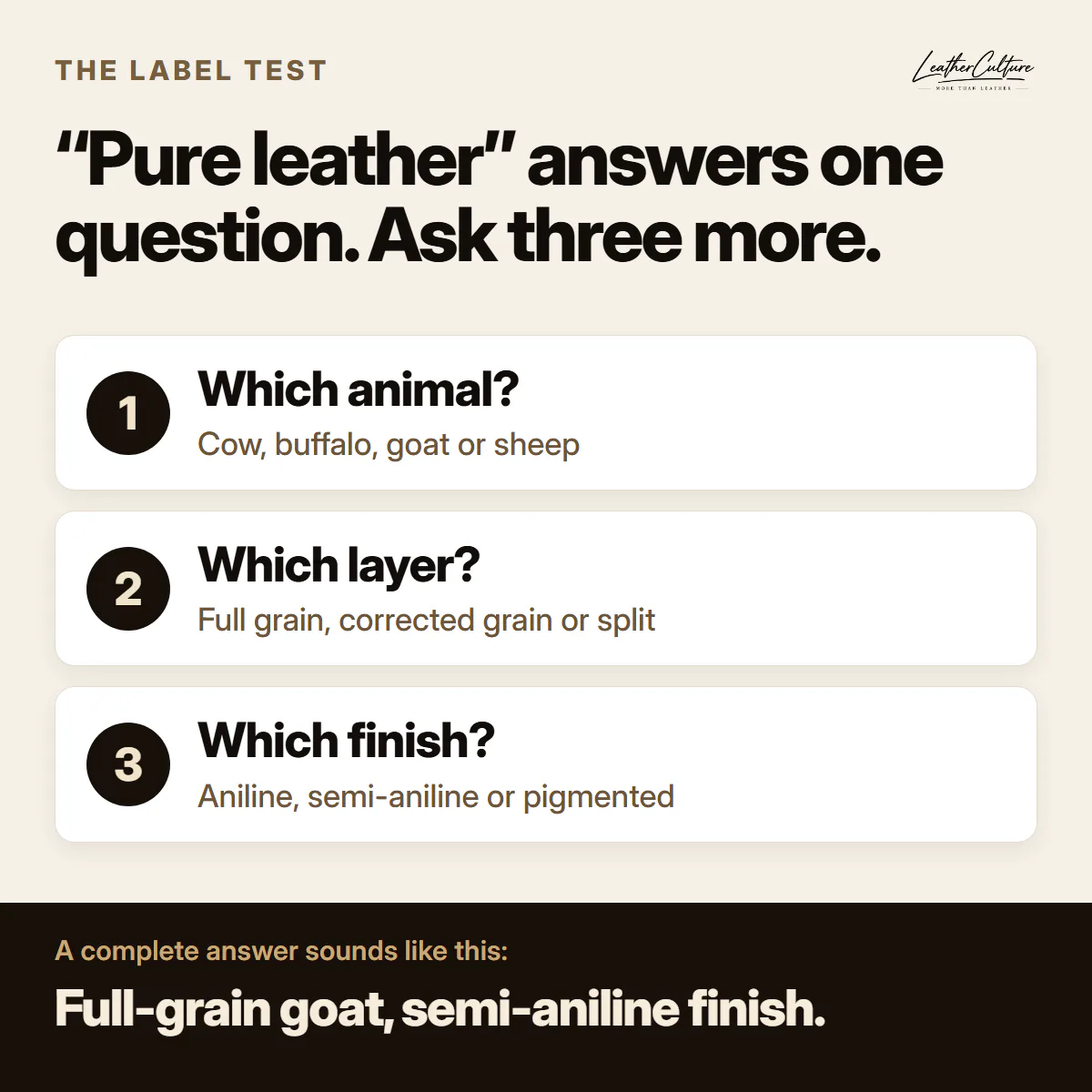
- Animal sets the natural weight, softness and grain pattern.
- Layer tells you which slice of the hide you are getting and how much of its original surface survived.
- Finish is whatever was applied on top, and it decides how the piece marks, cleans and ages.
Change one part and you have a different product, even when the listing photo looks identical. A full-grain goat jacket with a semi-aniline finish and a corrected-grain cow jacket with a pigmented finish can both honestly be called pure or original leather. The first shows natural character and marks more readily. The second looks even, wipes clean and changes less with age. Neither one is a fraud, but you should know which one you are paying for.
Question 1: which animal? Cow, buffalo, goat or sheep
Pakistan produces leather from cow, buffalo, sheep and goat, mostly from animals kept by small-scale herders for meat, and its leather apparel factories sit mainly in Karachi and Sialkot. Our city guide to buying original leather explains what that means for shoppers. Because the raw material is a by-product of the food supply, Eid-ul-Adha shapes the market. Before Eid in 2026, Pakistan Tanners Association chairman Hamid Arshad Zahur told Arab News that tanners expected about 2.8 million cows and bulls, 4.3 million goats and 500,000 sheep to be slaughtered.
Those figures cover one festival rather than a full year, and Pakistan also imports some hides and skins. They are still a useful reminder. Goat and cow are everyday materials here, so neither should be presented to you as something rare, and "sheep" on a local label is worth confirming rather than assuming.
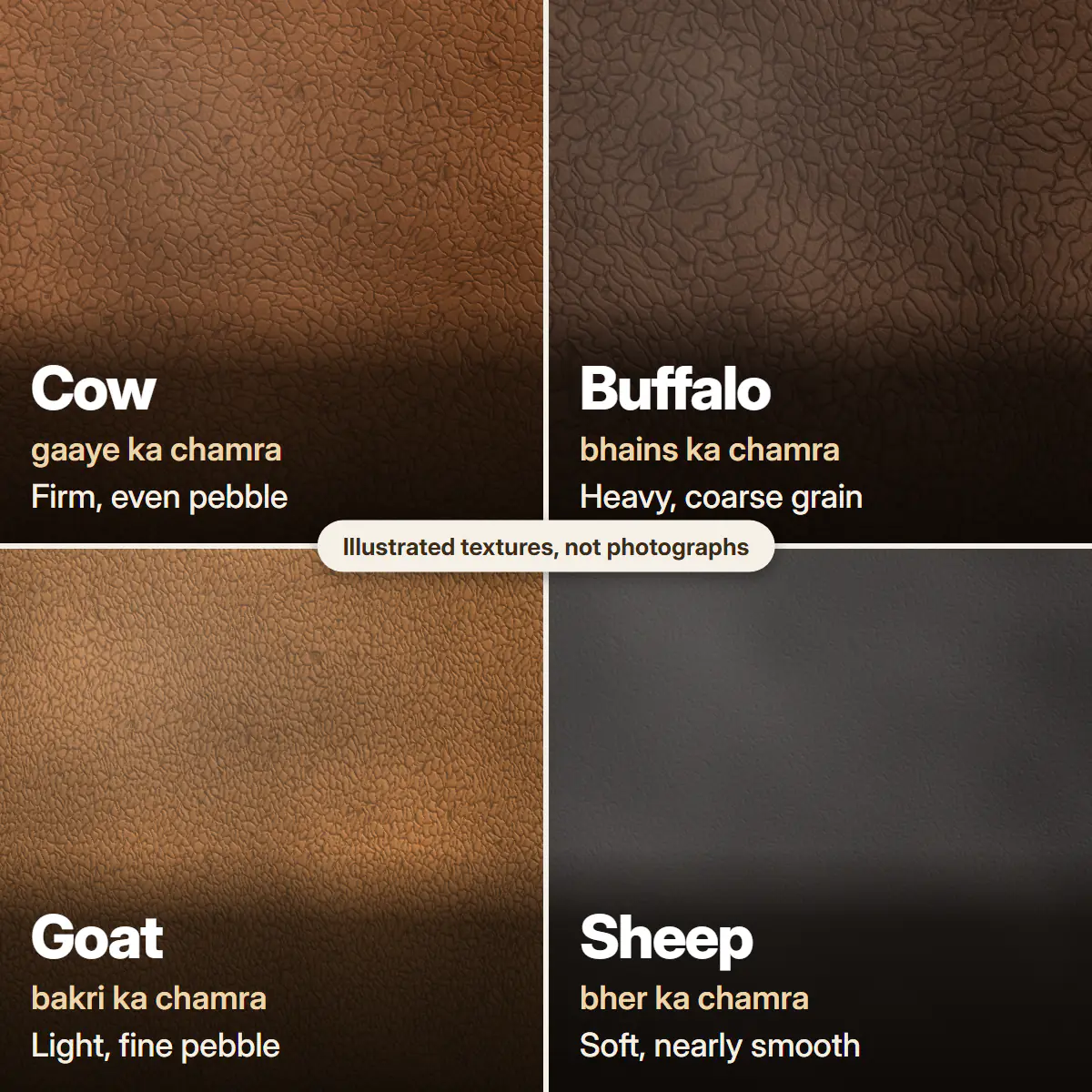
| Animal | Natural character | Works best for | Worth checking |
|---|---|---|---|
| Cow (gaaye) | Firm, medium to heavy, even pebbled grain | Everyday jackets, belts, structured bags, formal shoes | How thick the panels are, and whether the surface was corrected |
| Buffalo (bhains) | Thick, coarser grain, more visible pores | Boots, sandals, rugged bags, heavy winter jackets | Total weight, and whether it will be too warm for your city |
| Goat (bakri) | Light, flexible, fine tight pebble | Light jackets, gloves, soft bags, small goods | Thin, heavily shaved panels, especially at stress points |
| Sheep or lamb (bher) | Softest and lightest, smooth, drapes well | Soft fashion jackets, gloves, linings | Scuffs and tears more easily, so avoid rough daily use |
The grain pattern works a little like the animal's fingerprint. Canada's Conservation Institute explains that each species has a characteristic surface, mainly because of the size, density and distribution of its hair follicles. Just do not trust your eyes alone, because a pattern can be stamped on. US guidance even uses the example of cowhide processed to imitate pigskin, and says the real kind of leather should be disclosed.
Cow leather (gaaye ka chamra)
This is the all-rounder. Cattle hides are large and thick, so a tannery can cut long panels and split them to whatever thickness a product needs. The result holds its shape, which suits belts, structured bags, formal shoes and jackets that will see daily wear. The trade-off is a firmer first few weeks. Expect a new cow jacket to feel stiff across the shoulders until it has been worn in.
Buffalo leather (bhains ka chamra)
Think of buffalo as cow's more rugged relative: generally thicker, with a coarser grain and pores you can easily see. It earns its place on boots, sandals, work bags and heavy jackets where toughness matters more than drape. One caution when reading foreign guides is that American listings often say "buffalo" when they mean bison, a different animal from the water buffalo behind Pakistani buffalo leather, so their advice does not always carry over.
Goat leather (bakri ka chamra)
Goat has a fine, tight pebble and a light, flexible feel, which makes it a natural fit for everyday jackets, gloves, soft bags and small goods. Its reputation for toughness deserves some nuance, though. One patent filing on goat leather gives typical grain-to-corium thickness ratios of 25:75 for cattle and 45:55 for goat, and says most of the strength comes from the corium. Shave a goat skin too thin and little of that strength remains. A study of Brazilian goat skins adds another caveat: strength tracked the density of the finished leather, and properties shifted with the animal's age. "Goat" on a label is a starting point, not a guarantee.
Sheep leather (bher ka chamra)
Sheep and lamb give the softest hand of the four. A sheep jacket drapes easily and feels comfortable from day one, which explains its popularity in fashion styles. That softness comes with a more delicate surface and lower resistance to tearing than a heavier hide, so it is a poor match for a bag that gets thrown around or a jacket worn on a motorbike. For real cold, look at shearling, which is sheepskin tanned with its wool left on and trimmed to an even length.
Question 2: which layer? Full grain, corrected grain, split or suede
A hide is too thick for most products, so a machine usually slices it horizontally. The top slice, carrying the natural face, is called the grain split. The slice beneath is the flesh split, and very heavy hides can also yield a middle split. Almost every grade name you will see describes what happened at this stage.
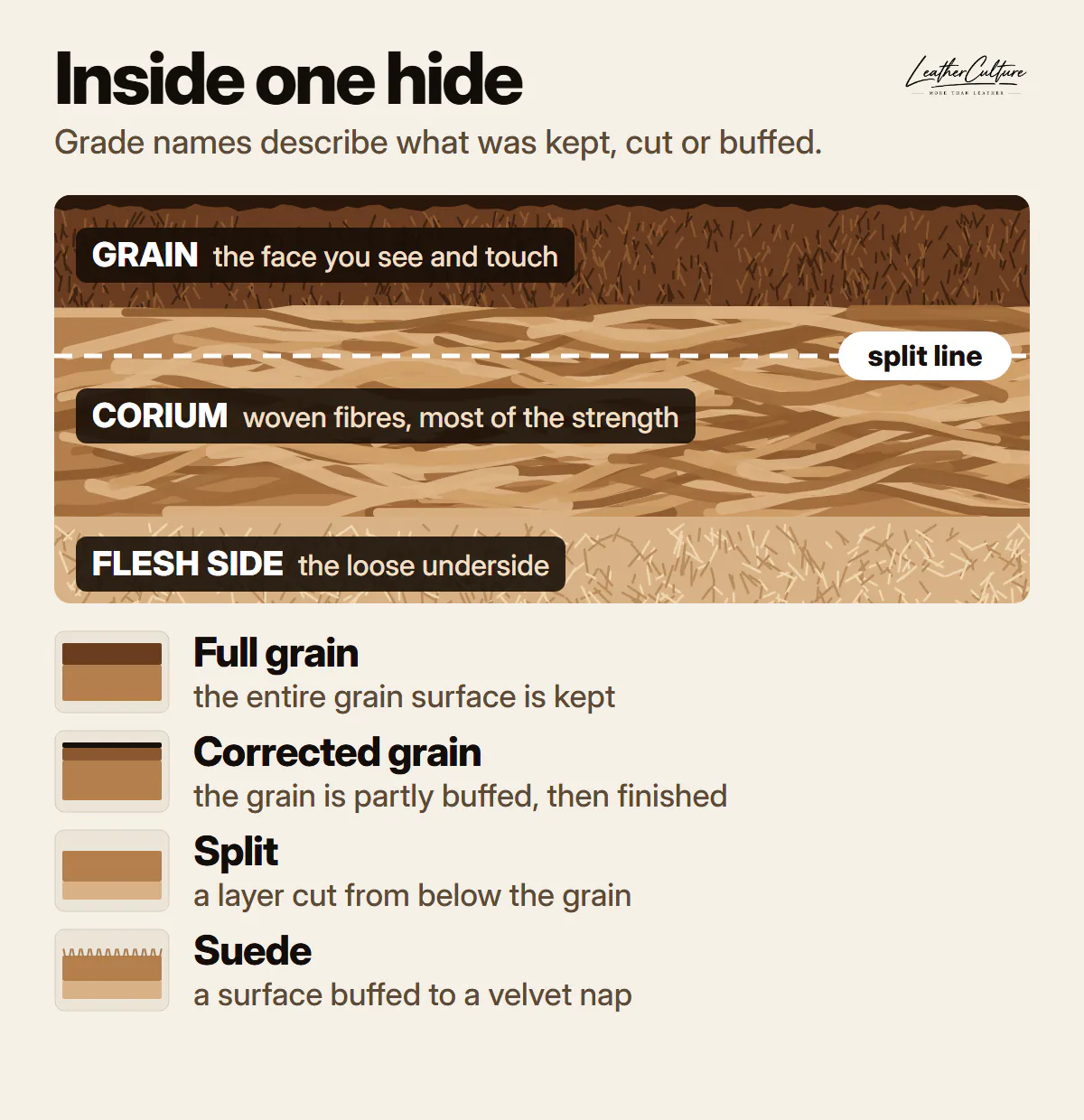
It helps to know what each zone does. The grain is the face you see and touch. Under it sits the corium, a thick weave of collagen fibres, and the goat leather patent filing puts it plainly: "the majority of the strength comes from the corium". So a good piece keeps a healthy amount of corium behind its grain, and a thin, over-shaved panel can disappoint even when its surface looks perfect.
- Full grain: the entire grain stays, with nothing sanded away. Pores, small scars and natural variation remain, so the tannery has to begin with a decent hide. This is the layer that develops the deepest patina.
- Corrected grain: the grain has been partly buffed off and then rebuilt with a finish, sometimes with a printed pattern. It is still real leather. It looks more uniform and hides flaws, but part of the surface you see is manufactured.
- "Top grain": not a term the LWG list defines. Sellers use it for anything from lightly sanded grain to plainly corrected leather, so ask the follow-up: has the surface been buffed?
- Split leather: a layer from below the grain. With no natural face of its own, it is either napped into suede or coated to imitate grain. That is fine for linings and budget pieces, as long as it is called what it is.
- Suede: leather or split leather whose wearing surface has been mechanically finished to a velvet-like nap. Much of it is cut from splits, so it feels lovely and marks quickly.
- Nubuck: leather buffed to a velvety surface while the original grain pattern stays visible. It is easy to mistake for suede, but it starts from the grain side.
- Bonded leather: ground fibres and a binder rolled into a sheet. The European definition of leather fibre board asks for at least 50% dry leather fibre by weight. It is not leather, and an honest label states the content, along the lines of the FTC's example, "Bonded Leather Containing 60% Leather Fibers".
So is "genuine leather" the lowest grade?
You will read that claim on many leather blogs, and it is only half true. Genuine leather is not a rung on any formal ladder, and it does not appear in the LWG list at all. It simply means real leather with nothing further disclosed. Makers with full-grain material usually say so, which means a bare "genuine leather" stamp often does sit on a corrected or split product. Treat it as an unanswered question rather than a grade, and ask which layer it is.
Question 3: which finish? Aniline, semi-aniline or pigmented
Finish is the part most shoppers never ask about, yet it decides how a piece behaves in dust, rain and daily handling. These are the names you are most likely to come across.
| Finish | What it is | In daily use |
|---|---|---|
| Aniline | Natural grain clearly visible, with no coating or a very thin clear one | The most natural look and feel, but it absorbs stains and marks readily |
| Semi-aniline | A finish with a small amount of pigment, leaving the grain clearly visible | A middle path, with natural character and a little more protection |
| Pigmented | A pigmented finish that completely conceals the grain | Even colour and easy to wipe, though it feels the least natural |
| Napa or nappa | Soft full-grain leather, dyed through and lightly finished | Soft and pleasant to wear. The word names no animal, so ask which one |
| Pull-up | Leather designed to lighten in colour when stretched | Shows folds and handling, which many people enjoy as character |
| Coated | A surface coating thicker than 0.15 mm, up to a third of the total thickness | Very protective, but the face you touch is mostly the coating |
How much difference can a finish make? One Leather International summary of the European furniture-leather standard EN 13336 put the wet-rub requirement at 250 rubs for pigmented leather against 80 for semi-aniline. That is furniture rather than fashion, and the article dates from 2008, but it shows why two items sold as pure leather can age so differently.
Here is a quick shop test, if the seller allows it. Put one small drop of water on a hidden area and watch for a few seconds. If it soaks in and darkens the surface, the finish is light and closer to aniline. If it sits on top, there is a protective coating. Wipe it off straight away either way.
What do common Pakistani leather labels really mean?
Use this table when you are reading a listing or standing in a shop. The last column gives you the follow-up that turns each phrase into something you can actually compare.
| On the label | What it tells you | Still unknown | Ask this |
|---|---|---|---|
| 100% pure leather | A claim that it is real hide | Animal, layer, finish | Which animal, and which layer? |
| Original or asli leather | The same claim in different words | Animal, layer, finish | Has the surface been corrected? |
| Genuine leather | Real leather, with no grade stated | Layer above all | Is it full grain, corrected or split? |
| Pure sheep or lamb | The animal | Layer, finish, thickness | Is it full grain, and how thick is it? |
| Cow leather or cowhide | The animal | Grain side or split | Is this the grain side or a coated split? |
| Nappa | Soft, lightly finished leather | The animal | Nappa from which animal? |
| Suede | A napped surface | Real leather or microfibre, and which layer | Is it leather suede, and is it a split? |
| Full grain | The surface should be intact | Animal, finish | Can you send a close-up of the pores? |
| Bonded leather | Fibres and binder, not leather | Fibre percentage | What percentage is leather fibre? |
| PU, PVC, rexine, leatherette, vegan leather | A synthetic material | Its durability and backing | Is the price fair for a synthetic? |
A synthetic is not automatically a bad purchase, and our five-year value test helps when you are weighing the two. The only real problem is paying a leather price for something that is not leather.
Which leather is best for jackets, shoes, bags, wallets and belts?
No hide wins every category. For a jacket that most Pakistani buyers will wear through an ordinary winter, full-grain goat or medium-weight cow is the safest place to begin. For everything else, use the job the item has to do as your guide.
| Item | Good starting point | Why | Watch out for |
|---|---|---|---|
| Everyday jacket | Goat or medium-weight cow, full grain | Light enough for most of the season, tough enough for regular wear | A poor fit, which no hide can fix. Check the size guide |
| Winter or riding jacket | Cow or buffalo, full grain | More thickness against wind and scrapes | A fashion jacket is not certified riding protection |
| Soft fashion jacket | Sheep or lamb nappa | Drape and comfort from the first wear | Scuffs, and straps that rub at the shoulder |
| Formal shoes | Full-grain or well-corrected cow | Holds its shape and takes polish | A good upper on a poor lining or sole |
| Everyday shoes and chappals | Cow or buffalo | Stands up to repeated flexing and heat | A hard break-in period, so check the size carefully |
| Work or travel bag | Full-grain or pigmented cow | Structure, and a surface that copes with handling | Weak strap anchors and coated splits at stress points |
| Soft handbag | Goat or sheep | Lightness and slouch | Sheep marks easily against buckles and keys |
| Wallet or card holder | Goat, sheep or thin cow | Thin panels keep it from getting bulky | Bonded sheets that start to peel at the folds |
| Belt | Full-grain cow or buffalo | Resists stretching and constant bending | Bonded or coated belts peeling around the holes |
LeatherCulture sells jackets today, with bags, shoes and accessories planned, so treat the other rows as general guidance rather than a description of our range. If you are mainly choosing a jacket, our complete jacket guide goes much further on fit, construction and style.
Which pure leather suits your city?
Climate rarely appears on a label, but it matters. The Canadian Conservation Institute warns that mould finds leather easy to colonise once relative humidity climbs past 65%. On one Sunday in August 2025, Dawn reported Karachi at 82 per cent in the morning and 57 per cent in the evening. A jacket that is perfect for Gilgit can spend most of its life in a Karachi wardrobe, so match the weight to where you will really wear it.
- Karachi, Hyderabad and the coast: choose lighter goat or sheep, and a finish that is easy to wipe. Keep leather in a breathable cotton cover rather than plastic.
- Lahore, Multan and the Punjab plains: medium cow or goat handles a short, sharp winter. Semi-aniline and pigmented finishes cope better with dust and smog than bare aniline or suede.
- Islamabad, Peshawar and Quetta: colder winters justify a heavier cow jacket with a proper lining. Lining often does as much for warmth as the hide does.
- Murree, Swat, Gilgit and the north: this is where heavy cow, buffalo and shearling really earn their weight.
Whichever you choose, our leather care guide for Pakistan covers storage, damp and conditioning in more detail.
What should you ask a seller before you pay?
Many online sellers in Pakistan take orders through WhatsApp or Instagram, which makes it easy to get a clear written answer. Copy this and fill in the product name.
Salam. Before I order [product name], please confirm: 1) Which animal is the outer leather from? 2) Is it full grain, corrected grain or split? 3) What finish does it have? 4) Are all panels the same material, and what is the lining? 5) Please send a close-up of the surface and of a seam or inside edge.
Copy this message (Roman Urdu)Salam. Order se pehle yeh confirm kar dein: 1) Bahar wala leather kis janwar ka hai: gaaye, bhains, bakri ya bher? 2) Full grain hai, corrected grain hai ya split? 3) Finish kaunsi hai? 4) Kya saare panels aik hi material ke hain, aur lining kis cheez ki hai? 5) Surface aur silai ki close-up tasveer bhej dein.
Then read the reply carefully. A strong answer names the animal and the layer, sends real photographs, and sometimes says "let me check with the workshop". A weak answer repeats the slogan: "100% pure hai, tension na lein". A written reply is not laboratory proof, but it is a specific claim you can point to later, so keep the screenshot and read the seller's returns terms before paying. Our online buying checklist covers the rest of that process.
Use the same message on us. LeatherCulture's current product records do not yet name an animal or grade for each jacket, so this guide does not assign one. Before ordering from our leather jacket collection, ask our team through the contact page to confirm the shell material, lining and construction of the exact jacket you want.
Asli leather ki pehchan kaise karein?
Agar aap Google par "asli leather ki pehchan" ya "pure leather ki pehchan kaise kare" likh kar yahan aaye hain, to yeh chaar aasan tareeqe hain. Koi bhi aik test poora saboot nahi hota, is liye in sab ko mila kar dekhein.
- Kinara dekhein. Asli leather ke kate hue kinare par resha resha sa material nazar aata hai. Agar kinare par kapray ki tah ya plastic ki layer dikhe, to woh aam tor par PU ya rexine hota hai.
- Ungli se dabayein. Asli leather dabane par halki si jhurriyan banati hai aur phir wapas apni jagah aa jati hai. Rexine aksar seedha andar dhans jata hai aur sakht mehsoos hota hai.
- Pattern dekhein. Agar poori jacket par bilkul aik jaisa design repeat ho raha ho, to woh stamp ho sakta hai. Asli grain mein thora farq hota hai. Magar yaad rakhein ke corrected leather par bhi stamp lag sakta hai.
- Seller se teen sawal poochein. Kis janwar ka leather hai? Kaunsi layer hai? Finish kaunsi hai? Jo seller waqai jaanta hai woh seedha jawab de ga.
Jala kar check karne wala test na karein. Is se cheez kharab ho jati hai aur natija bhi pakka nahi hota.
Prefer English? Our four quick checks for real leather walk through the same hands-on tests.
Frequently asked questions about pure leather in Pakistan
What is pure leather made of?
It is made from animal hide or skin that has been tanned so it will not rot. In Pakistan that usually means cow, buffalo, goat or sheep. If the material has been shredded and bonded into a sheet, or is a plastic coating on fabric, it does not meet the trade definition of leather.
What does original leather mean?
It means the seller is claiming real animal hide rather than a synthetic. In Pakistan, original leather, pure leather and asli leather are used almost interchangeably. None of them is a grade, so treat the phrase as the start of your questions rather than the end of them.
What are the types of original leather?
They are the same as the types of pure leather. Sort them by animal (cow, buffalo, goat or sheep), by layer (full grain, corrected grain, split or suede) and by finish (aniline, semi-aniline or pigmented). One item always has an answer in all three groups.
What is the difference between pure leather and genuine leather?
In everyday selling they make the same claim, that the item is real hide. Neither is a defined grade, and neither appears in the Leather Working Group's list of trade definitions. Ask which animal, layer and finish the item uses, because those answers tell you far more than either phrase.
Is genuine leather the lowest quality?
Not by definition. It is not a formal rung on any scale. However, makers with full-grain material usually advertise it, so a bare "genuine leather" stamp often appears on corrected or split leather. Treat it as a reason to ask which layer you are getting.
Is sheep leather good for jackets?
Yes, if softness and light weight are your priorities. Sheep leather drapes well and needs little breaking in. It also scuffs and tears more easily than cow, so it suits city wear better than motorbike riding or rough daily use.
Sheep leather or cow leather: which is better for a jacket in Pakistan?
Choose cow for hard wear, structure and colder winters. Choose sheep for comfort, drape and lighter use, especially in a warm city. Layer and finish matter just as much, so a full-grain sheep jacket and a heavily corrected cow jacket are not a simple like-for-like comparison.
Is goat leather better than cow leather?
Not automatically. Goat is lighter and more flexible, with a fine pebbled grain, which suits jackets, gloves and small goods. Cow is thicker and holds its shape better, which suits belts and structured bags. A thin, heavily shaved goat skin can also be weaker than its reputation suggests.
Is buffalo leather good quality?
It can be. Buffalo is generally thick and hard-wearing, with a coarser grain and more visible pores than cow, which makes it a good choice for boots, sandals and rugged bags. Quality still depends on the layer, the tanning and the construction, so the animal alone does not settle the matter.
Is pure leather waterproof?
No. Heavily finished leather resists light rain better than aniline or suede, but none of them is waterproof. If a piece gets wet, blot it with a soft cloth and leave it to air-dry, well away from heaters and strong sun.
What is the difference between pure leather and PU leather or rexine?
Pure leather comes from a tanned hide with its natural fibres intact. PU and rexine are synthetic coatings on a backing, usually fabric, made to look like leather. A cut edge often gives it away, because leather shows fibres while a synthetic shows a fabric layer under a plastic skin.
How can I check original leather at home?
Look at a cut edge for fibres rather than a fabric backing, press the surface to see whether natural creases form, and check whether the pattern repeats exactly. No single test is proof, especially with stamped or corrected leather. Our four quick checks explain each one.
How much does a pure leather jacket cost in Pakistan?
Prices vary too widely for one honest figure, because animal, layer, finish, construction and brand all change the cost. A price alone cannot prove the material. LeatherCulture's current jackets were listed at Rs 15,000 each on 1 November 2026, and our price guide explains how to compare the full delivered cost.
Buy the description, not the slogan
A leather piece is only as trustworthy as the sentence used to sell it. The next time a listing says pure leather or original leather, ask for the full sentence: animal, layer and finish. Once you have that, comparing two jackets becomes a real comparison instead of a guess. When you are ready, browse the LeatherCulture jacket collection, take your measurements with the size guide, and send us the questions above before you order.