
When people search for original leather in Pakistan, they usually want a simple answer: is it real, and will it last? Material matters, but a hide does not turn itself into a useful jacket, bag or wallet. The result depends on the craft choices made around it—how the pattern is placed, where panels meet, how the edges are finished and how every moving part is secured.
There is no single “pure leather type” that guarantees a better item. Cow, buffalo, goat and sheep leather all behave differently. What you can judge as a buyer is whether the maker or seller describes the material clearly, shows the construction closely and has made sensible choices for the item’s job.
What “original leather” means in a workshop
In everyday Pakistani shopping language, original leather, pure leather and real leather usually mean a product made from an animal hide rather than a plastic lookalike. That is a useful starting point, but it is not a full specification. A reliable description names the material where possible: cowhide, buffalo, goatskin, lambskin or another leather type, as well as the finish or lining when those details matter.
Leather can have a natural grain, a lightly corrected surface, a suede finish or a protective coating. None of those words automatically makes a product good or bad. They tell you how the surface will feel, wear and respond to care. The key is that the description matches the item and is not used to hide a different material. The US Federal Trade Commission’s guidance, for example, says bonded or reconstituted material should not be represented simply as leather. While that is US guidance rather than Pakistani law, the buyer lesson is universal: ask for a specific material answer.
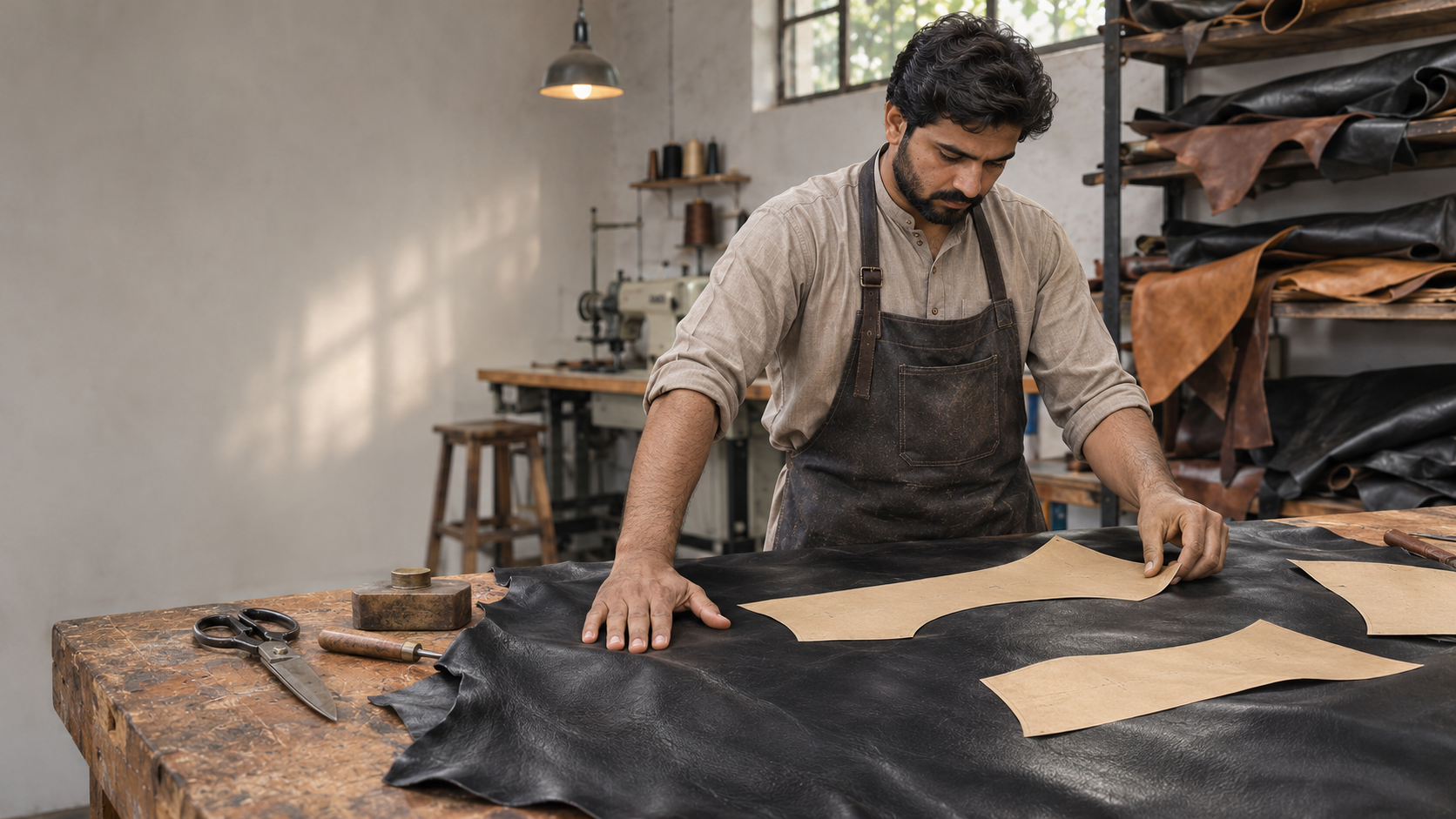
From hide to finished piece: the practical journey
Every workshop has its own sequence, but most well-made leather goods pass through the same decisions. First, the material must suit the intended product. A light, soft hide may work beautifully for a flexible jacket, while a structured bag or belt needs a material and construction that can cope with more weight and pulling.
Then comes pattern work. Paper or card templates help a maker repeat a shape and plan the layout before cutting. Large, clean panels are useful where the design needs a smooth appearance; smaller offcuts can be appropriate for tabs, facings and internal components. The aim is not to remove every natural mark—real leather has variation—but to place the material thoughtfully.
After cutting, edges may be folded, painted, burnished or bound depending on the design. Panels are stitched together, hardware is attached and the lining is fitted. That final assembly determines whether a product feels composed in the hand or merely looks good from a distance.
Six craft details you can inspect before buying
1. Pattern placement and panel matching
Look at the front, back and sleeves or side panels. Grain, colour and texture do not have to be identical—natural leather varies—but adjacent pieces should look intentionally paired. A maker who has considered the layout avoids putting an awkward mark or a radically different texture in the most visible place unless it is part of the design.
2. Seams at stress points
Seams carry movement. On a jacket, inspect shoulders, armholes, pockets and the zip area. On a bag, inspect handle anchors, strap loops and the base corners. Stitching should be even, secure and suited to the thickness of the material. Loose ends, skipped stitches or visibly pulled holes are reasons to ask more questions.
3. Cut edges and finishing
Edges are where daily handling shows first. A cleanly folded, painted or burnished edge helps a product look finished and reduces the chance of rough layers catching on clothing. Check cuffs, collars, pocket openings, bag flaps and straps closely. The finish should look consistent rather than thickly painted to hide a rough cut.
4. Lining that supports the outer leather
A lining is not an afterthought. It helps the item slide on, protects the inside and gives pockets and zips a tidy anchor. In photos, it should lie flat and meet the leather cleanly. A lining that pulls tight around the arm, pocket or zip can become a weak point long before the outer material wears out.
5. Hardware chosen for the load
Zips, snaps, rings and buckles do different jobs. A light snap may suit a small pocket; a shoulder strap or briefcase handle needs more substantial attachment points. Ask for a close photo or short video of the hardware when the listing does not show it clearly. Smooth movement and secure fitting are more meaningful than a shiny finish alone.
6. A useful balance between structure and softness
Good leather construction matches the feel to the item. A racer jacket often benefits from a cleaner, firmer line; a soft overshirt may need more drape; a laptop bag needs enough structure to protect its contents. “Stiff” is not automatically better, and neither is “soft.” The right balance depends on how you will use it.
| Area | What a helpful listing shows | Question to ask if it is missing |
|---|---|---|
| Material | The hide or a clear material description | “What is the outer material and finish?” |
| Construction | Front, back, side and close seam photos | “Can I see the shoulder, pocket or strap attachment?” |
| Interior | Lining, inside pocket and zip detail | “What is the lining made from, and is there an inside pocket?” |
| Hardware | Close-up or short video of zips and fasteners | “Can you show the zip and hardware working?” |
| Fit or capacity | Measurements and useful context | “Which size/contents is this design made for?” |
Matching pure leather type to the job
Searching for a pure leather type is sensible when you have a specific use in mind. Cowhide and buffalo leather are often chosen where structure and resilience are useful. Goatskin can offer strength at a lighter weight and has a naturally distinctive grain. Lambskin tends to feel softer and drape more easily, which can suit dressier garments but calls for gentler treatment. The hide is only one part of the decision: finish, thickness, lining and construction still matter.
Our detailed guide to leather types in Pakistan explains these terms in more depth. If you are comparing natural leather with a synthetic option, read original leather versus faux leather before you order.
How to ask about craftsmanship when shopping online
You do not need to sound like a factory inspector. Three simple questions get you useful information:
- “What is the outer material, and which leather type is it?”
- “Can you share a close photo of the inside, the seam and the zip or hardware?”
- “If the item arrives with a different material, measurement or defect, what is the exchange process?”
Specific answers are a better sign than a repeated slogan. Keep the product description and the seller’s reply until the order is complete. For a broader pre-payment list, use our original leather online buying checklist.
Why construction changes the care routine
How an item is built affects how it should be stored. Preserve the shape of bags with clean paper, hang jackets on broad hangers and avoid crushing collars, folds or straps. Dust can be removed with a soft dry cloth. If leather becomes wet, blot it and let it dry gradually at room temperature, away from direct heat.
Humidity deserves attention during Pakistan’s damp months. The Canadian Conservation Institute notes that relative humidity above 65% favours mould growth on leather. Give stored items air, avoid long-term plastic covers and check them occasionally instead of leaving them packed away for a season.
Frequently asked questions
How can I tell whether original leather was crafted well?
Look for a clear material description, purposeful panel layout, even stitching, clean edge finishing, a flat lining and hardware that suits the product’s load. No single detail proves quality, so judge the full construction.
Does natural variation mean the leather is defective?
Not necessarily. Natural leather can show pores, grain changes and small marks. The question is whether the variation has been placed and finished thoughtfully, rather than whether the surface looks identical everywhere.
What is the best pure leather type for a jacket?
There is no single best type. Cowhide and buffalo suit more structured, hard-wearing styles; goatskin is light and strong; lambskin is soft and supple. Choose the one that fits your preferred weight, feel and use.
Can I judge leather craftsmanship from online photos?
You can make a more informed decision if the listing shows close images of the seams, edges, lining and hardware. If it does not, ask for those views and read the exchange terms before paying.
Why should I avoid storing leather in plastic?
Leather benefits from airflow. In humid conditions, trapped moisture can support mould growth. A breathable cover and space around the item are safer for long-term storage.
Buy the construction, not only the claim
Original leather is worth understanding because it is a material that can be repaired, cared for and enjoyed for years. But the visible craftsmanship is what turns that material into a dependable item. Take a moment to inspect the details, ask direct questions and choose a design built for the way you live. Browse the LeatherCulture collection for current pieces or contact the team for product information.